
Chapter: Excretory Products and Their Elimination
0 of 53 questions completed
Questions:
- 1
- 2
- 3
- 4
- 5
- 6
- 7
- 8
- 9
- 10
- 11
- 12
- 13
- 14
- 15
- 16
- 17
- 18
- 19
- 20
- 21
- 22
- 23
- 24
- 25
- 26
- 27
- 28
- 29
- 30
- 31
- 32
- 33
- 34
- 35
- 36
- 37
- 38
- 39
- 40
- 41
- 42
- 43
- 44
- 45
- 46
- 47
- 48
- 49
- 50
- 51
- 52
- 53
Information
Subject: Biology
Syllabus: Excretory Products and Their Elimination
Duration: 45 Min.
Read the following instruction carefully.
- There are 53 total questions in this test
- Each question has 4 options out of which only one is correct.
- You will be awarded 4 points for each correct answer and 1 point will be deducted for each wrong answer.
- Try not to guess the answer as there is negative marking.
- Your Score & Rank will be shown after submitting the test.
- In this quiz you are going to check your conceptual knowledge.
You have already completed the Test before. Hence you can not start it again.
Test is loading...
You must sign in or sign up to start the Test.
You have to finish following quiz, to start this Test:
Your results are here!! for" NPY_11_Bio_19_19_Excretory Products and Their Elimination "
0 of 53 questions answered correctly
Your time:
Time has elapsed
Your Final Score is : 0
You have attempted : 0
Number of Correct Questions : 0 and scored 0
Number of Incorrect Questions : 0 and Negative marks 0
| Average score |
|
| Your score |
|
-
Not categorized
You have attempted: 0
Number of Correct Questions: 0 and scored 0
Number of Incorrect Questions: 0 and Negative marks 0
-
Level 1
You have attempted: 0
Number of Correct Questions: 0 and scored 0
Number of Incorrect Questions: 0 and Negative marks 0
-
Dear $form{0} you have completed this test.
| Pos. | Name | Entered on | Points | Result |
|---|---|---|---|---|
| Table is loading | ||||
| No data available | ||||
- 1
- 2
- 3
- 4
- 5
- 6
- 7
- 8
- 9
- 10
- 11
- 12
- 13
- 14
- 15
- 16
- 17
- 18
- 19
- 20
- 21
- 22
- 23
- 24
- 25
- 26
- 27
- 28
- 29
- 30
- 31
- 32
- 33
- 34
- 35
- 36
- 37
- 38
- 39
- 40
- 41
- 42
- 43
- 44
- 45
- 46
- 47
- 48
- 49
- 50
- 51
- 52
- 53
- Answered
- Review
-
Question 1 of 53
1. Question
4 pointsMatch the items in Column-I with those in Column II
Column I Column II
1. Podocytes i. Crystallised oxalates
2. Protonephridia ii. Annelids
3. Nephridia iii. Amphioxus
4. Renal calculi iv. Filtration slits
Select the correct option from the following -
Question 2 of 53
2. Question
4 pointsUricotelic mode of passing out nitrogenous wastes is found in
-
Question 3 of 53
3. Question
4 pointsWhich one of the following is not a part of a renal pyramid?
-
Question 4 of 53
4. Question
4 pointsUric acid is the chief nitrogenous component of the excretory products of
-
Question 5 of 53
5. Question
4 pointsConsider the following four statements (A–D) about certain desert animals such as kangaroo rat
A. They have dark colour and high rate of reproduction and excrete solid urine.
B. They do not drink water, breathe at a slow rate to conserve water and have their body covered with thick hairs.
C. They feed on dry seeds and do not require drinking water.
D. They excrete very concentrated urine and do not use water to regulate body temperature.
Which two of the above statements for such animals are true? -
Question 6 of 53
6. Question
4 pointsIn Ornithine cycle which one pair of the following wastes are removed from the blood?
-
Question 7 of 53
7. Question
4 pointsUricotelism is found in
-
Question 8 of 53
8. Question
4 pointsIn living beings, ammonia is converted into urea through
-
Question 9 of 53
9. Question
4 pointsThe enteronephric nephridia of earthworms are mainly concerned with
-
Question 10 of 53
10. Question
4 pointsAquatic reptiles are
-
Question 11 of 53
11. Question
4 pointsIn ureotelic animals, urea is formed by
-
Question 12 of 53
12. Question
4 pointsThe kidney of an adult frog is
-
Question 13 of 53
13. Question
4 pointsUric acid is nitrogenous waste in
-
Question 14 of 53
14. Question
4 pointsNitrogenous waste products are eliminated mainly as
-
Question 15 of 53
15. Question
4 pointsMatch the items given in Column I with those in Column II and select the correct option given below
Column-I Column-II
(Function) (Part of Excretory System)
1. Ultrafiltration i. Henle’s loop
2. Concentration of urine ii. Ureter
3. Transport of urine iii. Urinary bladder
4. Storage of urine iv. Malpighian corpuscle
. v. Proximal convoluted tubule -
Question 16 of 53
16. Question
4 pointsFigure shows human urinary system with structures labelled A-D.
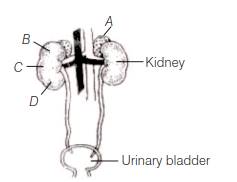
Select option, which correctly identifies them and gives their characteristics and/of functions
-
Question 17 of 53
17. Question
4 pointsThe principal nitrogenous excretory compound in humans is synthesised
-
Question 18 of 53
18. Question
4 pointsWhat will happen if the stretch receptors of the urinary bladder wall are totally removed?
-
Question 19 of 53
19. Question
4 pointsBowman’s glands are found in
-
Question 20 of 53
20. Question
4 pointsPart not belonging to uriniferous tubule is
-
Question 21 of 53
21. Question
4 pointsProximal and distal convoluted tubules are parts of
-
Question 22 of 53
22. Question
4 pointsBrush border is characteristic of
-
Question 23 of 53
23. Question
4 pointsThe increase in osmolarity from outer to inner medullary interstitium is maintained due to
I. close proximity between Henle’s loop and vasa recta
II. counter-current mechanism
III. selective secretion of \(\begin{align}HCO_{3}^{-} \end{align}\) and hydrogen ions in PCT.
IV. higher blood pressure in glomerular capillaries -
Question 24 of 53
24. Question
4 pointsMatch the following parts of a nephron with their function.
Column I Column II
1. Descending limb of Henle’s loop (i) Reabsorption of salts only
2. Proximal convoluted tubule (ii) Reabsorption of water only
3. Ascending limb of Henle’s loop (iii) Conditional reabsorption of sodium ion and water
4. Distal convoluted tubule (iv) Reabsorption of ion, water and organic nutrients
Select the correct option from the following. -
Question 25 of 53
25. Question
4 pointsWhich of the following statements is correct?
-
Question 26 of 53
26. Question
4 pointsThe part of nephron involved in active reabsorption of sodium is
-
Question 27 of 53
27. Question
4 pointsWhich of the following causes an increase in sodium reabsorption in the distal convoluted tubule?
-
Question 28 of 53
28. Question
4 pointsThe maximum amount of electrolytes and water (70-80%) from the glomerular filtrate is reabsorbed in which part of the nephron?
-
Question 29 of 53
29. Question
4 pointsWhich one of the following correctly explains the function of a specific part of a human nephron?
-
Question 30 of 53
30. Question
4 pointsInjury to adrenal cortex is not likely to affect the secretion of which one of the following?
-
Question 31 of 53
31. Question
4 pointsWhich one of the following statements in regard to the excretion by the human kidneys is correct?
-
Question 32 of 53
32. Question
4 pointsThe net pressure gradient that causes the fluid to filter out of the glomeruli into the capsule is
-
Question 33 of 53
33. Question
4 pointsIf Henle’s loop were absent from mammalian nephron, which of the following is to be expected?
-
Question 34 of 53
34. Question
4 pointsThe ability of the vertebrates to produce concentrated (hyperosmotic) urine usually depends upon the
-
Question 35 of 53
35. Question
4 pointsThe basic functional unit of human kidney is
-
Question 36 of 53
36. Question
4 pointsUnder normal conditions which one is completely reabsorbed in the renal tubule?
-
Question 37 of 53
37. Question
4 pointsReabsorption of useful substances from glomerular filtrate occurs in
-
Question 38 of 53
38. Question
4 pointsSelect the correct statement.
-
Question 39 of 53
39. Question
4 pointsWhich of the following factors is responsible for the formation of concentrated urine?
-
Question 40 of 53
40. Question
4 pointsA decrease in blood pressure/volume will not cause the release of
-
Question 41 of 53
41. Question
4 pointsHuman urine is usually acidic because
-
Question 42 of 53
42. Question
4 pointsWhich one of the following statements is correct with respect to kidney function regulation?
-
Question 43 of 53
43. Question
4 pointsA person who is on a long hunger strike and is surviving only onwater, will have
-
Question 44 of 53
44. Question
4 pointsAngiotensinogen is a protein produced and secreted by
-
Question 45 of 53
45. Question
4 pointsA person is undergoing prolonged fasting. His urine will be found to contain abnormal quantities of
-
Question 46 of 53
46. Question
4 pointsGlucose is taken back from glomerular filtrate through
-
Question 47 of 53
47. Question
4 pointsWhich one of the following is correctly matched pair of the given secretion and its primary role in human physiology?
-
Question 48 of 53
48. Question
4 pointsPresence of which of the following conditions in urine are indicative of diabetes mellitus?
-
Question 49 of 53
49. Question
4 pointsWhich of the following would help in prevention of diuresis?
-
Question 50 of 53
50. Question
4 pointsUse of an artificial kidney during hemodialysis may result in :
A. Nitrogenous waste build-up in the body.
B. Non-elimination of excess potassium ions.
C. Reduced absorption of calcium ions from gastrointestinal tract.
D. Reduced RBC production
Which of the following options is the most appropriate? -
Question 51 of 53
51. Question
4 pointsMatch the items given in Column I with those in Column II and select the correct option given below
Column I Column II
1. Glycosuria (i) Accumulation of uric acid in joints.
2. Gout (ii) Mass of crystallised salts within the kidney.
3. Renal calculi (iii) Inflammation in glomeruli
4. Glomerular nephritis (iv) Presence of glucose in urine. -
Question 52 of 53
52. Question
4 pointsA condition of failure of kidney to form urine is called
-
Question 53 of 53
53. Question
4 pointsIf kidneys fail to reabsorb water, the effect on tissue would
