
Chapter: Neural Control and Coordination
0 of 75 questions completed
Questions:
- 1
- 2
- 3
- 4
- 5
- 6
- 7
- 8
- 9
- 10
- 11
- 12
- 13
- 14
- 15
- 16
- 17
- 18
- 19
- 20
- 21
- 22
- 23
- 24
- 25
- 26
- 27
- 28
- 29
- 30
- 31
- 32
- 33
- 34
- 35
- 36
- 37
- 38
- 39
- 40
- 41
- 42
- 43
- 44
- 45
- 46
- 47
- 48
- 49
- 50
- 51
- 52
- 53
- 54
- 55
- 56
- 57
- 58
- 59
- 60
- 61
- 62
- 63
- 64
- 65
- 66
- 67
- 68
- 69
- 70
- 71
- 72
- 73
- 74
- 75
Information
Subject: Biology
Syllabus: Neural Control and Coordination
Duration: 1 Hr.
Read the following instruction carefully.
- There are 75 total questions in this test
- Each question has 4 options out of which only one is correct.
- You will be awarded 4 points for each correct answer and 1 point will be deducted for each wrong answer.
- Try not to guess the answer as there is negative marking.
- Your Score & Rank will be shown after submitting the test.
- In this quiz you are going to check your conceptual knowledge.
You have already completed the Test before. Hence you can not start it again.
Test is loading...
You must sign in or sign up to start the Test.
You have to finish following quiz, to start this Test:
Your results are here!! for" NPY_11_Bio_21_21_Neural Control and Coordination "
0 of 75 questions answered correctly
Your time:
Time has elapsed
Your Final Score is : 0
You have attempted : 0
Number of Correct Questions : 0 and scored 0
Number of Incorrect Questions : 0 and Negative marks 0
| Average score |
|
| Your score |
|
-
Not categorized
You have attempted: 0
Number of Correct Questions: 0 and scored 0
Number of Incorrect Questions: 0 and Negative marks 0
-
Level 1
You have attempted: 0
Number of Correct Questions: 0 and scored 0
Number of Incorrect Questions: 0 and Negative marks 0
-
Dear $form{0} you have completed this test.
| Pos. | Name | Entered on | Points | Result |
|---|---|---|---|---|
| Table is loading | ||||
| No data available | ||||
- 1
- 2
- 3
- 4
- 5
- 6
- 7
- 8
- 9
- 10
- 11
- 12
- 13
- 14
- 15
- 16
- 17
- 18
- 19
- 20
- 21
- 22
- 23
- 24
- 25
- 26
- 27
- 28
- 29
- 30
- 31
- 32
- 33
- 34
- 35
- 36
- 37
- 38
- 39
- 40
- 41
- 42
- 43
- 44
- 45
- 46
- 47
- 48
- 49
- 50
- 51
- 52
- 53
- 54
- 55
- 56
- 57
- 58
- 59
- 60
- 61
- 62
- 63
- 64
- 65
- 66
- 67
- 68
- 69
- 70
- 71
- 72
- 73
- 74
- 75
- Answered
- Review
-
Question 1 of 75
1. Question
4 pointsReceptor sites for neurotransmitters are present on
-
Question 2 of 75
2. Question
4 pointsMyelin sheath is produced by
-
Question 3 of 75
3. Question
4 pointsDestruction of the anterior horn cells of the spinal cord would result in loss of
-
Question 4 of 75
4. Question
4 pointsHow do parasympathetic neural signals affect the working of the heart?
-
Question 5 of 75
5. Question
4 pointsWhen a neuron is in resting state, i.e. not conducting any impulse, the axonal membrane is
-
Question 6 of 75
6. Question
4 pointsDuring the propagation of a nerve impulse, the action potential results from the movement of
-
Question 7 of 75
7. Question
4 pointsDuring the transmission of nerve impulse through a nerve fibre, the potential on the inner side of the plasma membrane has which type of electric charge?
-
Question 8 of 75
8. Question
4 pointsWhich one of the following pairs of structures distinguishes a nerve cell from other types of cell?
-
Question 9 of 75
9. Question
4 pointsWhich of the following statements is correct about node of Ranvier?
-
Question 10 of 75
10. Question
4 pointsWhich of the following is regarded as a unit of nervous tissue?
-
Question 11 of 75
11. Question
4 pointsThe junction between the axon of one neuron and the dendrite of the next is called
-
Question 12 of 75
12. Question
4 pointsSympathetic nervous system induces
-
Question 13 of 75
13. Question
4 pointsIn humans, visceral organs are innervated by
-
Question 14 of 75
14. Question
4 pointsAfferent nerve fibres carry impulses from
-
Question 15 of 75
15. Question
4 pointsOne function of parasympathetic nervous system is
-
Question 16 of 75
16. Question
4 pointsWhich of the following is associated with decrease in cardiac output?
-
Question 17 of 75
17. Question
4 pointsWhich of the following statements is not correct?
-
Question 18 of 75
18. Question
4 pointsWhich part of the brain is responsible for thermoregulation?
-
Question 19 of 75
19. Question
4 pointsStimulation of a muscle fibre by a motor neuron occurs at
-
Question 20 of 75
20. Question
4 pointsInjury localised to the hypothalamus would most likely disrupt
-
Question 21 of 75
21. Question
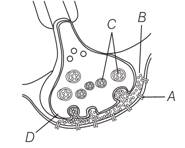
4 pointsA diagram showing axon terminal and synapse is given. Identify correctly at least two of A-D
-
Question 22 of 75
22. Question
4 pointsThe human hindbrain comprises three parts, one of which is
-
Question 23 of 75
23. Question
4 pointsThe nerve centres which control the body temperature and the urge for eating are contained in
-
Question 24 of 75
24. Question
4 pointsWhich part of human brain is concerned with the regulation of body temperature?
-
Question 25 of 75
25. Question
4 pointsWhich one of the following statements is correct?
-
Question 26 of 75
26. Question
4 pointsWhich one of the following do not act as a neurotransmitter?
-
Question 27 of 75
27. Question
4 pointsOne of the examples of the action of the autonomous nervous system is
-
Question 28 of 75
28. Question
4 pointsFour healthy people in their twenties got involved in injuries resulting in damage and death of a few cells of the following. Which of the cells are least likely to be replaced by new cells?
-
Question 29 of 75
29. Question
4 pointsIn the resting state of the neural membrane, diffusion due to concentration gradients, if allowed, would drive
-
Question 30 of 75
30. Question
4 pointsWhat used to be described as Nissl’s granules in a nerve cell are now identified as
-
Question 31 of 75
31. Question
4 pointsWhich cells do not form layer and remain structurally separate?
-
Question 32 of 75
32. Question
4 pointsAn action potential in the nerve fibre is produced when positive and negative charges on the outside and the inside of the axon membrane are reversed, because
-
Question 33 of 75
33. Question
4 pointsWhich cranial nerve has the highest number of branches?
-
Question 34 of 75
34. Question
4 pointsThe Nissl’s granules of nerve cell are made up of
-
Question 35 of 75
35. Question
4 pointsThe roof of the cranium of frog is formed by
-
Question 36 of 75
36. Question
4 pointsThe sympathetic nerves, in mammals arise from
-
Question 37 of 75
37. Question
4 pointsRespiratory centre is situated in
-
Question 38 of 75
38. Question
4 pointsCNS is mostly made of
-
Question 39 of 75
39. Question
4 pointsIvan Pavlov performed experiments on
-
Question 40 of 75
40. Question
4 pointsVagus nerve is
-
Question 41 of 75
41. Question
4 pointsThird ventricle of brain is also known as
-
Question 42 of 75
42. Question
4 pointsWhich of the following cranial nerves can regulate heartbeat?
-
Question 43 of 75
43. Question
4 pointsMatch the following columns and select the correct option from the codes given below.
Column I Column II
A. Rods and cones 1. Absence of photoreceptor cells
B. Blind spot 2. Cones are densely packed
C. Fovea 3. Photoreceptor cells
D. Iris 4. Visible coloured portion of the eye -
Question 44 of 75
44. Question
4 pointsMatch the following columns and select the correct option.
Column I Column II
A. Organ of Corti 1. Connects middle ear and pharynx
B. Cochlea 2. Coiled part of the labyrinth
C. Eustachian tube 3. Attached to the oval window
D. Stapes 4. Located on the basilar membrane -
Question 45 of 75
45. Question
4 pointsWhich of the following receptors are specifically responsible for maintenance of the balance of body and posture?
-
Question 46 of 75
46. Question
4 pointsWhich of the following statements is correct?
-
Question 47 of 75
47. Question
4 pointsThe transparent lens in the human eye is held in its place by
-
Question 48 of 75
48. Question
4 pointsPhotosensitive compound in human eye is made up of
-
Question 49 of 75
49. Question
4 pointsChoose the correct statement.
-
Question 50 of 75
50. Question
4 pointsIn mammalian eye, the ‘fovea’ is the center of the visual field, where
-
Question 51 of 75
51. Question
4 pointsWhich one of the following statements is not correct?
-
Question 52 of 75
52. Question
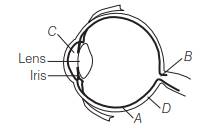
4 pointsParts A, B, C and D of the human eyes are shown in the diagram. Select the option, which gives correct identification along with its functions/characteristics
-
Question 53 of 75
53. Question
4 pointsWhich part of the human ear plays no role in hearing as such but is otherwise very much required?
-
Question 54 of 75
54. Question
4 pointsThe purplish red pigment rhodopsin contained in the rods type of photoreceptor cells of the human eyes is a derivative of
-
Question 55 of 75
55. Question
4 pointsCornea transplant in human is almost never rejected. This is because
-
Question 56 of 75
56. Question
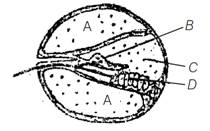
4 pointsGiven below is a diagrammatic cross section of a single loop of human cochlea.
Which one of the following options correctly represents the names of three different parts? -
Question 57 of 75
57. Question
4 pointsWhich one of the following is the correct difference between rod cells and cone cells of our retina?Rod cells Cone cells(P) Visual acuity High Low(Q) Visual pigment contained Iodopsin Rhodopsin(R) Overall function Vision in poor light Colour vision and detailed vision in bright light(S) Distribution More concentrated in centre of retina Evenly distributed all over retina
-
Question 58 of 75
58. Question
4 pointsBowman’s glands are located in the
-
Question 59 of 75
59. Question
4 pointsWhat is the intensity of sound in normal conversation?
-
Question 60 of 75
60. Question
4 pointsCharacteristic feature of human cornea is that
-
Question 61 of 75
61. Question
4 pointsWhen we migrate from dark to light, we fail to see for some time but after a time visibility becomes normal. It is an example of
-
Question 62 of 75
62. Question
4 pointsIn the chemistry of vision in mammals, the photosensitive substance is called
-
Question 63 of 75
63. Question
4 pointsIn frog, ‘fenestra ovalis’ is
-
Question 64 of 75
64. Question
4 pointsCornea transplantation is outstandingly successful because
-
Question 65 of 75
65. Question
4 pointsRetina is most sensitive at
-
Question 66 of 75
66. Question
4 pointsFunction of iris is to
-
Question 67 of 75
67. Question
4 pointsLight rays entering the eye are controlled by
-
Question 68 of 75
68. Question
4 pointsIris is part of
-
Question 69 of 75
69. Question
4 pointsSensitive pigmented layer of eye is
-
Question 70 of 75
70. Question
4 pointsAcute vision is present in
-
Question 71 of 75
71. Question
4 pointsSnow blindness in Antarctic region is due to
-
Question 72 of 75
72. Question
4 pointsIn a man, abducens nerve is injured. Which one of the following functions will be affected?
-
Question 73 of 75
73. Question
4 pointsParkinson’s disease (characterised by tremors and progressive rigidity of limbs) is caused by degeneration of brain neurons that are involved in movement control and make use of neurotransmitter
-
Question 74 of 75
74. Question
4 pointsInjury to vagus nerve in human is not likely to affect
-
Question 75 of 75
75. Question
4 pointsA person suffering from the deficiency of the visual pigment rhodopsin is advised to take more
