
Chapter: Work, Energy and Power
0 of 66 questions completed
Questions:
- 1
- 2
- 3
- 4
- 5
- 6
- 7
- 8
- 9
- 10
- 11
- 12
- 13
- 14
- 15
- 16
- 17
- 18
- 19
- 20
- 21
- 22
- 23
- 24
- 25
- 26
- 27
- 28
- 29
- 30
- 31
- 32
- 33
- 34
- 35
- 36
- 37
- 38
- 39
- 40
- 41
- 42
- 43
- 44
- 45
- 46
- 47
- 48
- 49
- 50
- 51
- 52
- 53
- 54
- 55
- 56
- 57
- 58
- 59
- 60
- 61
- 62
- 63
- 64
- 65
- 66
Information
Subject: Physics
Syllabus: Work, Energy and Power
Duration: 30 min.
Read the following instruction carefully.
- There are 30 total questions in this test
- Each question has 4 options out of which only one is correct.
- You will be awarded 4 points for each correct answer and 1 point will be deducted for each wrong answer.
- Try not to guess the answer as there is negative marking.
- Your Score & Rank will be shown after submitting the test.
- In this quiz you are going to check your conceptual knowledge.
You have already completed the Test before. Hence you can not start it again.
Test is loading...
You must sign in or sign up to start the Test.
You have to finish following quiz, to start this Test:
Your results are here!! for" NPY_11_Phy_05_Work, Energy and Power "
0 of 66 questions answered correctly
Your time:
Time has elapsed
Your Final Score is : 0
You have attempted : 0
Number of Correct Questions : 0 and scored 0
Number of Incorrect Questions : 0 and Negative marks 0
| Average score |
|
| Your score |
|
-
PYQ
You have attempted: 0
Number of Correct Questions: 0 and scored 0
Number of Incorrect Questions: 0 and Negative marks 0
-
Dear $form{0} you have completed this test.
| Pos. | Name | Entered on | Points | Result |
|---|---|---|---|---|
| Table is loading | ||||
| No data available | ||||
- 1
- 2
- 3
- 4
- 5
- 6
- 7
- 8
- 9
- 10
- 11
- 12
- 13
- 14
- 15
- 16
- 17
- 18
- 19
- 20
- 21
- 22
- 23
- 24
- 25
- 26
- 27
- 28
- 29
- 30
- 31
- 32
- 33
- 34
- 35
- 36
- 37
- 38
- 39
- 40
- 41
- 42
- 43
- 44
- 45
- 46
- 47
- 48
- 49
- 50
- 51
- 52
- 53
- 54
- 55
- 56
- 57
- 58
- 59
- 60
- 61
- 62
- 63
- 64
- 65
- 66
- Answered
- Review
-
Question 1 of 66
1. Question
4 pointsA particle is released from height \(\begin{align}S\end{align}\) from the surface of the Earth. At a certain height its kinetic energy is three times its potential energy. The height from the surface of earth and the speed of the particle at that instant are respectively
-
Question 2 of 66
2. Question
4 pointsThe energy required to break one bond in \(\begin{align}DNA\end{align}\) is \(\begin{align}{{10}^{{-20}}}\end{align}\)\(\begin{align}J\end{align}\). This value \(\begin{align}\left( {in\text{ }eV} \right)\end{align}\) is nearly
-
Question 3 of 66
3. Question
4 pointsA force \(\begin{align}F=20+10y\end{align}\) acts on a particle in y-direction, where \(\begin{align}F\end{align}\) is in newton and \(\begin{align}y\end{align}\) in meter. Work done by this force to move the particle from \(\begin{align}y=0\end{align}\)to \(\begin{align}y=1m\end{align}\) is
-
Question 4 of 66
4. Question
4 pointsA particle of mass \(\begin{align}10\text{ }g\end{align}\) moves along a circle of radius \(\begin{align}6.4\text{ }cm\end{align}\) with a constant tangential acceleration. What is the magnitude of this acceleration, if the kinetic energy of the particle becomes equal to \(\begin{align}8\times {{10}^{{-4}}}J\end{align}\) by the end of the second revolution after the beginning of the motion?
-
Question 5 of 66
5. Question
4 pointsA particle moves from a point \(\begin{align}\left( {-2\hat{i}+5\hat{j}} \right)\end{align}\) to \(\begin{align}\left( {4\widehat{j}+3\widehat{k}} \right)\end{align}\) when a force of \(\begin{align}\left( {4\widehat{i}+3\widehat{j}} \right)N\end{align}\) is applied. How much work has been done by the force?
-
Question 6 of 66
6. Question
4 pointsTwo similar springs \(\begin{align}P\end{align}\) and \(\begin{align}Q\end{align}\) have spring constants \(\begin{align}{{K}_{P}}\end{align}\) and \(\begin{align}{{K}_{Q}}\end{align}\) , such that \(\begin{align}{{K}_{P}}>{{K}_{Q}}\end{align}\) . They are stretched, first by the same amount \(\begin{align}\left( {case\text{ }a} \right)\end{align}\), then by the same force \(\begin{align}\left( {case\text{ }b} \right)\end{align}\). The work done by the springs \(\begin{align}{{W}_{P}}\end{align}\) and \(\begin{align}{{W}_{Q}}\end{align}\) are related as, in \(\begin{align}\left( {case\text{ }a} \right)\end{align}\) and \(\begin{align}\left( {case\text{ }b} \right)\end{align}\) , respectively
-
Question 7 of 66
7. Question
4 pointsA block of mass \(\begin{align}10\text{ }kg\end{align}\), moving in \(\begin{align}x\end{align}\)-direction with a constant speed of \(\begin{align}10\text{ }m{{s}^{{-1}}}\end{align}\), is subjected to a retarding force \(\begin{align}F=0.1\times J/m\end{align}\)during its travel from \(\begin{align}x=20\text{ }m\text{ }to30\,m\end{align}\). Its final \(\begin{align}KE\end{align}\) will be
-
Question 8 of 66
8. Question
4 pointsTwo particles of masses \(\begin{align}{{m}_{1}},{{m}_{2}}\end{align}\) move with initial velocities \(\begin{align}{{u}_{1}}\end{align}\) and \(\begin{align}{{u}_{2}}\end{align}\) . On collision, one of the particles get excited to higher level, after absorbing energy \(\begin{align}\varepsilon \end{align}\). If final velocities of particles be \(\begin{align}{{v}_{1}}\end{align}\) and \(\begin{align}{{v}_{2}}\end{align}\) , then we must have
-
Question 9 of 66
9. Question
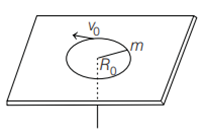
4 pointsA mass \(\begin{align}m\end{align}\) moves in a circle on a smooth horizontal plane with velocity \(\begin{align}{{v}_{0}}\end{align}\) at a radius \(\begin{align}{{R}_{0}}\end{align}\) . The mass is attached to a string which passes through a smooth hole in the plane as shown. The tension in the string is increased gradually and finally m moves in a circle of radius \(\begin{align}\frac{{{{R}_{0}}}}{2}\end{align}\) . The final value of the kinetic energy is
-
Question 10 of 66
10. Question
4 pointsA ball is thrown vertically downwards from a height of \(\begin{align}20m\end{align}\) with an initial velocity \(\begin{align}{{v}_{0}}\end{align}\) . It collides with the ground, loses \(\begin{align}50\%\end{align}\) of its energy in collision and rebounds to the same height. The initial velocity \(\begin{align}{{v}_{0}}\end{align}\) is \(\begin{align}\left( {Take,\text{ }g=10m{{s}^{{-2}}}} \right)\end{align}\)
-
Question 11 of 66
11. Question
4 pointsA uniform force of \(\begin{align}\left( {3\widehat{i}+\widehat{j}} \right)N\end{align}\)acts on a particle of mass \(\begin{align}2\,kg\end{align}\). Hence, the particle is displaced from position \(\begin{align}\left( {2i+\widehat{k}} \right)\end{align}\)\(\begin{align}m\end{align}\) to position \(\begin{align}\left( {4\widehat{i}+3\widehat{j}-\widehat{k}} \right)\end{align}\)\(\begin{align}m\end{align}\). The work done by the force on the particle is
-
Question 12 of 66
12. Question
4 pointsThe potential energy of a particle in a force field \(\begin{align}U=\frac{A}{{{{r}^{2}}}}-\frac{B}{r}\end{align}\), where \(\begin{align}A\end{align}\) and \(\begin{align}B\end{align}\)are positive constants and \(\begin{align}r\end{align}\) is the distance of particle from the centre of the field. For stable equilibrium, the distance of the particle is
-
Question 13 of 66
13. Question
4 pointsThe potential energy of a system increases, if work is done
-
Question 14 of 66
14. Question
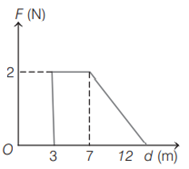
4 pointsForce \(\begin{align}F\end{align}\)on a particle moving in a straight line varies with distance d as shown in the figure. The work done on the particle during its displacement of \(\begin{align}12\,m\end{align}\) is
-
Question 15 of 66
15. Question
4 pointsA block of mass \(\begin{align}M\end{align}\) is attached to the lower end of a vertical spring. The spring is hung from a ceiling and has force constant value \(\begin{align}k\end{align}\). The mass is released from rest with the spring initially unstretched. The maximum extension produced in the length of the spring will be
-
Question 16 of 66
16. Question
4 pointsA body of mass \(\begin{align}1\,kg\end{align}\) is thrown upwards with a velocity \(\begin{align}20\,m{{s}^{{-1}}}\end{align}\) . It momentarily comes to rest after attaining a height of \(\begin{align}18\,m\end{align}\). How much energy is lost due to air friction? \(\begin{align}\left( {Take\,g=10\text{ }m{{s}^{{-2}}}} \right)\end{align}\)
-
Question 17 of 66
17. Question
4 points\(\begin{align}300\,J\end{align}\) of work is done in sliding a \(\begin{align}2\,kg\end{align}\) block up an inclined plane of height \(\begin{align}10\,m\end{align}\). Taking \(\begin{align}g=10\,m/{{s}^{2}}\end{align}\) , work done against friction is
-
Question 18 of 66
18. Question
4 pointsA body of mass \(\begin{align}3\text{ }kg\end{align}\) is under a constant force, which causes a displacement s in metre in it, given by the relation \(\begin{align}s=\frac{1}{3}{{\text{t}}^{2}}\end{align}\), where \(\begin{align}\text{t}\end{align}\) is in second. Work done by the force in \(\begin{align}\text{2}\,\text{s}\end{align}\) is
-
Question 19 of 66
19. Question
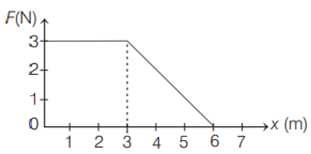
4 pointsA force \(\begin{align}F\end{align}\) acting on an object varies with distance \(\begin{align}x\end{align}\) as shown here. The force is in newton and \(\begin{align}x\end{align}\) is in metre. The work done by the force in moving the object from \(\begin{align}x\text{ }=\text{ }0\end{align}\) to \(\begin{align}x\text{ }=6\text{ }m\end{align}\)is
-
Question 20 of 66
20. Question
4 pointsA bomb of mass \(\begin{align}30\text{ }kg\end{align}\) at rest explodes into two pieces of masses \(\begin{align}18\text{ }kg\end{align}\)and \(\begin{align}12\text{ }kg\end{align}\). The velocity of \(\begin{align}18\,\,kg\end{align}\)mass is \(\begin{align}6\,m{{s}^{{-1}}}\text{ }\end{align}\). The kinetic energy of the other mass is
-
Question 21 of 66
21. Question
4 pointsA particle of mass \(\begin{align}{{m}_{1}}\end{align}\) is moving with a velocity \(\begin{align}{{v}_{1}}\end{align}\) and another particle of mass \(\begin{align}{{m}_{2}}\end{align}\) is moving with a velocity \(\begin{align}{{v}_{2}}\end{align}\) . Both of them have the same momentum, but their different kinetic energies are \(\begin{align}{{E}_{1}}\end{align}\) and\(\begin{align}{{E}_{2}}\end{align}\) respectively. If \(\begin{align}{{m}_{1}}>{{m}_{2}}\end{align}\) , then
-
Question 22 of 66
22. Question
4 pointsA ball of mass \(\begin{align}2\,kg\end{align}\) and another of mass \(\begin{align}4\text{ }kg\end{align}\) are dropped together from a \(\begin{align}60\text{ }ft\end{align}\) tall building. After, a fall of \(\begin{align}30\text{ }ft\end{align}\) each towards earth, their respective kinetic energies will be in the ratio of
-
Question 23 of 66
23. Question
4 pointsIf kinetic energy of a body is increased by \(\begin{align}300\,\%\end{align}\), then percentage change in momentum will be
-
Question 24 of 66
24. Question
4 pointsA stone is thrown at an angle of \(\begin{align}45{}^\circ \end{align}\) to the horizontal with kinetic energy \(\begin{align}K\end{align}\). The kinetic energy at the highest point is
-
Question 25 of 66
25. Question
4 pointsA child is swinging a swing. Minimum and maximum heights of swing from the earth's surface are \(\begin{align}0.75\text{ }m\end{align}\)and \(\begin{align}2\text{ }m\end{align}\) respectively. The maximum velocity of this swing is
-
Question 26 of 66
26. Question
4 pointsTwo bodies with kinetic energies in the ratio \(\begin{align}4:1\end{align}\) are moving with equal linear momentum. The ratio of their masses is
-
Question 27 of 66
27. Question
4 pointsA force acts on a \(\begin{align}3.0\text{ }g\end{align}\) particle in such a way that the position of the particle as a function of time is given by \(\begin{align}x=3t-4{{t}^{2}}+{{t}^{3}}\end{align}\),where \(\begin{align}\text{x}\end{align}\) is in metre and \(\begin{align}t\end{align}\) in second. The work done during the first \(\begin{align}4\end{align}\) s is
-
Question 28 of 66
28. Question
4 pointsA rubber ball is dropped from a height of \(\begin{align}\text{5}\,\text{m}\end{align}\) on a planet where the acceleration due to gravity is not known. On bouncing it rises to \(\begin{align}1.8\text{ }m\end{align}\). The ball loses its velocity on bouncing by a factor of
-
Question 29 of 66
29. Question
4 pointsIf the momentum of a body is increased by \(\begin{align}50\%\end{align}\), then the percentage increase in its kinetic energy is
-
Question 30 of 66
30. Question
4 pointsThe \(\begin{align}\text{KE}\end{align}\) acquired by a mass \(\begin{align}\text{m}\end{align}\) in travelling a certain distance \(\begin{align}\text{d}\end{align}\), starting from rest, under the action of a constant force is directly proportional to
-
Question 31 of 66
31. Question
4 pointsTwo masses \(\begin{align}1\text{ }g\end{align}\) and \(\begin{align}9\text{ }g\end{align}\) are moving with equal kinetic energies. The ratio of the magnitudes of their respective linear momenta is
-
Question 32 of 66
32. Question
4 pointsA position dependent force \(\begin{align}\text{F=}\left( {7-2\times 3{{x}^{2}}} \right)\text{N}\end{align}\), acts on a small body of mass \(\begin{align}2\text{ }kg\end{align}\) and displaces it from \(\begin{align}x=0\end{align}\)to \(\begin{align}x=5m\end{align}\). Work done in joule is
-
Question 33 of 66
33. Question
4 pointsA bullet of mass \(\begin{align}10\text{ }g\end{align}\) leaves a rifle at an initial velocity of \(\begin{align}1000\text{ }m/s\end{align}\)and strikes the earth at the same level with a velocity of \(\begin{align}500\text{ }m/s\end{align}\). The work done in joule to overcome the resistance of air will be
-
Question 34 of 66
34. Question
4 pointsWater falls from a height of 60 m at the rate of \(\begin{align}15\,kg/s\end{align}\) to operate a turbine. The losses due to frictional force are \(\begin{align}10\%\end{align}\) of the input energy. How much power is generated by the turbine? \(\begin{align}\left( {g=10\,m/{{s}^{2}}} \right)\end{align}\)
-
Question 35 of 66
35. Question
4 pointsA point mass \(\begin{align}m\end{align}\) is moved in a vertical circle of radius \(\begin{align}r\end{align}\) with the help of a string. The velocity of the mass is \(\begin{align}\sqrt{{7gr}}\end{align}\) at the lowest point. The tension in the string at the lowest point is
-
Question 36 of 66
36. Question
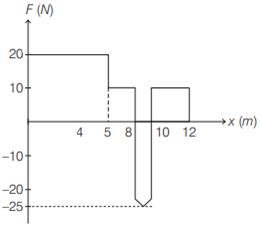
4 pointsAn object of mass \(\begin{align}500\text{ }g\end{align}\), initially at rest acted upon by a variable force whose \(\begin{align}X\end{align}\) component varies with X in the manner shown. The velocities of the object a point\(\begin{align}X=8\,m\end{align}\) and \(\begin{align}X=12\,m\text{ }\end{align}\), would be the respective values of (nearly)
-
Question 37 of 66
37. Question
4 pointsA mass m is attached to a thin wire and whirled in a vertical circle. The wire is most likely to break when:
-
Question 38 of 66
38. Question
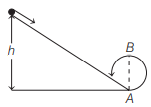
4 pointsA body initially at rest and sliding along a frictionless track from a height \(\begin{align}h\end{align}\) (as shown in the figure) just completes a vertical circle of diameter \(\begin{align}AB=D\end{align}\). The height \(\begin{align}h\end{align}\)is equal to
-
Question 39 of 66
39. Question
4 pointsConsider a drop of rain water having mass \(\begin{align}1\text{ }g\end{align}\) falling from a height of \(\begin{align}1\text{ }km\end{align}\). It hits the ground with a speed of \(\begin{align}50\text{ }m/s\end{align}\). Take g constant with a value of \(\begin{align}10\text{ }m/{{s}^{2}}\end{align}\). The work done by the (i) gravitational force and the (ii) resistive force of air is
-
Question 40 of 66
40. Question
4 pointsA body of mass \(\begin{align}1\text{ }kg\end{align}\)begins to move under the action of a time dependent force\(\begin{align}F=\left( {2t\widehat{i}+3{{t}^{2}}\widehat{j}} \right)N\end{align}\), where \(\begin{align}\widehat{i}\end{align}\) and \(\begin{align}\widehat{j}\end{align}\)are unit vectors along \(\begin{align}X\end{align}\) and \(\begin{align}Y\end{align}\) axes. What power will be developed by the force at the time \(\begin{align}\left( t \right)\end{align}\) ?
-
Question 41 of 66
41. Question
4 pointsWhat is the minimum velocity with which a body of mass \(\begin{align}m\end{align}\) must enter a vertical loop of radius \(\begin{align}R\end{align}\) so that it can complete the loop?
-
Question 42 of 66
42. Question
4 pointsA particle of mass \(\begin{align}m\end{align}\) is driven by a machine that delivers a constant power \(\begin{align}k\end{align}\) watts. If the particle starts from rest, the force on the particle at time \(\begin{align}t\end{align}\) is
-
Question 43 of 66
43. Question
4 pointsThe heart of a man pumps \(\begin{align}5\text{ }L\end{align}\) of blood through the arteries per minute at a pressure of \(\begin{align}150\text{ }mm\end{align}\)of mercury. If the density of mercury be \(\begin{align}13.6\times {{10}^{3}}\,kg/{{m}^{3}}\end{align}\) and \(\begin{align}g=10\,m/{{s}^{2}}\end{align}\), then the power of heart in watt is
-
Question 44 of 66
44. Question
4 pointsAn engine pumps water through a hose pipe. Water passes through the pipe and leaves it with a velocity of \(\begin{align}2m{{s}^{{-1}}}\end{align}\) . The mass per unit length of water in the pipe is \(\begin{align}100\text{ }kg\text{ }{{m}^{{-1}}}\end{align}\). What is the power of the engine?
-
Question 45 of 66
45. Question
4 pointsAn engine pumps water continuously through a hose. Water leaves the hose with a velocity \(\begin{align}v\end{align}\) and \(\begin{align}m\end{align}\) is the mass per unit length of the water jet. What is the rate at which kinetic energy is imparted to water?
-
Question 46 of 66
46. Question
4 pointsWater falls from a height of \(\begin{align}60\,m\end{align}\) at the rate of \(\begin{align}15\text{ }kg/s\end{align}\) to operate a turbine. The losses due to frictional forces are \(\begin{align}10\%\end{align}\) of energy. How much power is generated by the turbine ? \(\begin{align}\left( {Take\,g=10m/{{s}^{2}}} \right)\end{align}\)
-
Question 47 of 66
47. Question
4 pointsA stone is tied to a string of length \(\begin{align}l\end{align}\) and is whirled in a vertical circle with the other end of the string as the centre. At a certain instant of time, the stone is at its lowest position and has a speed \(\begin{align}u\end{align}\). The magnitude of the change in velocity as it reaches a position where the string is horizontal (\(\begin{align}g\end{align}\) being acceleration due to gravity) is
-
Question 48 of 66
48. Question
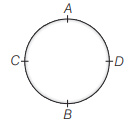
4 pointsA stone is attached to one end of a string and rotated in a vertical circle. If string breaks at the position of maximum tension, it will break at
-
Question 49 of 66
49. Question
4 pointsHow much water a pump of \(\begin{align}2\text{ }kW\end{align}\)can raise in one minute to a height of \(\begin{align}10\text{ }m\end{align}\)? \(\begin{align}\left( {Take\,g=10m/{{s}^{2}}} \right)\end{align}\)
-
Question 50 of 66
50. Question
4 pointsAn object flying in air with velocity \(\begin{align}\left( {20\widehat{i}+25\widehat{j}-12\widehat{k}} \right)\end{align}\)suddenly breaks in two pieces whose masses are in the ratio \(\begin{align}1:5\end{align}\). The smaller mass flies off with a velocity \(\begin{align}\left( {100\widehat{i}+35\widehat{j}+8\widehat{k}} \right)\end{align}\). The velocity of the larger piece will be
-
Question 51 of 66
51. Question
4 pointsA particle of mass \(\begin{align}5\text{ }m\end{align}\) at rest suddenly breaks on its own into three fragments. Two fragments of mass \(\begin{align}m\end{align}\) each move along mutually perpendicular direction with each speed \(\begin{align}v\end{align}\). The energy released during the process is
-
Question 52 of 66
52. Question
4 pointsBody \(\begin{align}A\end{align}\) of mass \(\begin{align}4m\end{align}\) moving with speed \(\begin{align}u\end{align}\) collides with another body \(\begin{align}B\end{align}\)of mass \(\begin{align}2m\end{align}\), at rest. The collision is head on and elastic in nature. After the collision the fraction of energy lost by the colliding body \(\begin{align}A\end{align}\) is
-
Question 53 of 66
53. Question
4 pointsA moving block having mass \(\begin{align}m\end{align}\), collides with another stationary block having mass\(\begin{align}4m\end{align}\). The lighter block comes to rest after collision. When the initial velocity of the lighter block is \(\begin{align}v\end{align}\), then the value of coefficient of restitution \(\begin{align}\left( e \right)\end{align}\) will be
-
Question 54 of 66
54. Question
4 pointsTwo identical balls \(\begin{align}A\end{align}\) and \(\begin{align}B\end{align}\)having velocities of \(\begin{align}0.5\text{ }m/s\end{align}\) and respectively collide elastically in one dimension. The velocities of \(\begin{align}B\end{align}\) and \(\begin{align}A\end{align}\) after the collision respectively will be
-
Question 55 of 66
55. Question
4 pointsOn a frictionless surface, a block of mass \(\begin{align}M\end{align}\) moving at speed \(\begin{align}v\end{align}\) collides elastically with another block of same mass \(\begin{align}M\end{align}\) which is initially at rest. After collision the first block moves at an angle \(\begin{align}\theta \end{align}\) to its initial direction and has a speed \(\begin{align}v/3\end{align}\). The second block's speed after the collision is
-
Question 56 of 66
56. Question
4 pointsA body of mass \(\begin{align}\left( {4m} \right)\end{align}\) is lying in \(\begin{align}xy-plane\end{align}\) at rest. It suddenly explodes into three pieces. Two pieces each of mass \(\begin{align}\left( m \right)\end{align}\) move perpendicular to each other with equal speeds \(\begin{align}\left( v \right)\end{align}\) . The total kinetic energy generated due to explosion is
-
Question 57 of 66
57. Question
4 pointsA ball moving with velocity \(\begin{align}2\text{ }m{{s}^{{-1}}}\end{align}\) collides head on with another stationary ball of double the mass. If the coefficient of restitution is \(\begin{align}0.5\end{align}\), then their velocities \(\begin{align}\left( {in\,m{{s}^{{-1}}}} \right)\end{align}\)after collision will be
-
Question 58 of 66
58. Question
4 pointsAn explosion blows a rock into three parts. Two parts go off at right angles to each other. These two are, \(\begin{align}1\text{ }kg\end{align}\) first part moving with a velocity \(\begin{align}12m{{s}^{{-1}}}\end{align}\)and \(\begin{align}2\text{ }kg\end{align}\)second part moving with a velocity of \(\begin{align}8m{{s}^{{-1}}}\end{align}\). If the third part flies off with a velocity of \(\begin{align}4m{{s}^{{-1}}}\end{align}\) , its mass would be
-
Question 59 of 66
59. Question
4 pointsA shell of mass \(\begin{align}200\text{ }g\end{align}\) is ejected from a gun of mass \(\begin{align}4\text{ }kg\end{align}\)by an explosion that generates \(\begin{align}1.05\text{ }kJ\text{ }\end{align}\) of energy. The initial velocity of the shell is
-
Question 60 of 66
60. Question
4 pointsA stationary particle explodes into two particles of masses \(\begin{align}{{m}_{1}}\end{align}\) and \(\begin{align}{{m}_{2}}\end{align}\), which move in opposite directions with velocities \(\begin{align}{{v}_{1}}\end{align}\) and \(\begin{align}{{v}_{2}}\end{align}\) . The ratio of their kinetic energies \(\begin{align}{{E}_{1}}/{{E}_{2}}\end{align}\) is
-
Question 61 of 66
61. Question
4 pointsTwo equal masses \(\begin{align}{{m}_{1}}\end{align}\) and \(\begin{align}{{m}_{2}}\end{align}\) moving along the same straight line with velocities \(\begin{align}+3\,m/s\end{align}\) and \(\begin{align}-5\,m/s\end{align}\)respectively collide elastically. Their velocities after the collision will be respectively
-
Question 62 of 66
62. Question
4 pointsA metal ball of mass \(\begin{align}2\text{ }kg\end{align}\)moving with a velocity of \(\begin{align}36\text{ }km/h\end{align}\)has a head on collision with a stationary ball of mass \(\begin{align}3\text{ }kg\end{align}\). If after the collision, the two balls move together, the loss in kinetic energy due to collision is
-
Question 63 of 66
63. Question
4 pointsA metal ball of mass \(\begin{align}2\text{ }kg\end{align}\) moving with a velocity of \(\begin{align}36\text{ }km/h\end{align}\) has a head on collision with a stationary ball of mass \(\begin{align}3\text{ }kg\text{ }\end{align}\). If after the collision, the two balls move together, the loss in kinetic energy due to collision is
-
Question 64 of 66
64. Question
4 pointsA body of mass \(\begin{align}m\end{align}\) moving with velocity \(\begin{align}3km/h\end{align}\) collides with a body of mass \(\begin{align}2\text{ }m\end{align}\) at rest. Now, the coalesced mass starts to move with a velocity
-
Question 65 of 66
65. Question
4 pointsTwo identical balls \(\begin{align}A\end{align}\) and \(\begin{align}B\end{align}\)moving with velocities \(\begin{align}+0.5\text{ }m/s\end{align}\) and \(\begin{align}-0.3\text{ }m/s\end{align}\)respectively, collide head on elastically. The velocity of the balls \(\begin{align}A\end{align}\) and \(\begin{align}B\end{align}\) after collision will be respectively
-
Question 66 of 66
66. Question
4 pointsThe coefficient of restitution e for a perfectly elastic collision is
