
Chapter: Anatomy of Flowering Plants – Mock Test -Level-1
0 of 30 questions completed
Questions:
- 1
- 2
- 3
- 4
- 5
- 6
- 7
- 8
- 9
- 10
- 11
- 12
- 13
- 14
- 15
- 16
- 17
- 18
- 19
- 20
- 21
- 22
- 23
- 24
- 25
- 26
- 27
- 28
- 29
- 30
Information
Subject: Biology
Syllabus: Chapter 6 : Anatomy of Flowering Plants
Duration: 30 min.
Read the following instruction carefully.
- There are 30 total questions in this test
- Each question has 4 options out of which only one is correct.
- You will be awarded 4 points for each correct answer and 1 point will be deducted for each wrong answer.
- Try not to guess the answer as there is negative marking.
- Your Score & Rank will be shown after submitting the test.
- In this quiz you are going to check your conceptual knowledge.
You have already completed the Test before. Hence you can not start it again.
Test is loading...
You must sign in or sign up to start the Test.
You have to finish following quiz, to start this Test:
Your results are here!! for" 23_Mock_Neet_Bio_L1_Chapter 6 : Anatomy of Flowering Plants "
0 of 30 questions answered correctly
Your time:
Time has elapsed
Your Final Score is : 0
You have attempted : 0
Number of Correct Questions : 0 and scored 0
Number of Incorrect Questions : 0 and Negative marks 0
| Average score |
|
| Your score |
|
-
Not categorized
You have attempted: 0
Number of Correct Questions: 0 and scored 0
Number of Incorrect Questions: 0 and Negative marks 0
-
Level 1
You have attempted: 0
Number of Correct Questions: 0 and scored 0
Number of Incorrect Questions: 0 and Negative marks 0
-
Dear $form{0} you have completed this test.
| Pos. | Name | Entered on | Points | Result |
|---|---|---|---|---|
| Table is loading | ||||
| No data available | ||||
- 1
- 2
- 3
- 4
- 5
- 6
- 7
- 8
- 9
- 10
- 11
- 12
- 13
- 14
- 15
- 16
- 17
- 18
- 19
- 20
- 21
- 22
- 23
- 24
- 25
- 26
- 27
- 28
- 29
- 30
- Answered
- Review
-
Question 1 of 30
1. Question
4 pointsWhen some permanent cells gets back to meristematic activity, it is referred to as
-
Question 2 of 30
2. Question
4 pointsMark the lateral meristem
-
Question 3 of 30
3. Question
4 pointsAccording to korper-kappe concept the body of the root is derived from
-
Question 4 of 30
4. Question
4 pointsAerenchyma is usually found in
-
Question 5 of 30
5. Question
4 pointsThe thickening in xylem appears on
-
Question 6 of 30
6. Question
4 pointsAerenchyma is helpful to plant by
-
Question 7 of 30
7. Question
4 pointsWhich statement is wrong
(a) In conjoint vascular bundle xylem and phloem are located on different radii
(b) When xylem is in centre surrounded on all sides by phloem then vascular bundle is known as Amphicribal vascular bundle
(c) All tissues on the innerside of the endodermis such as pericycle, vascular bundles and pith constitute the stele
(d) The inner most layer of the cortex is called endodermis -
Question 8 of 30
8. Question
4 pointsWhich of the following is / are correct statement
(a) Exarch xylem condition present in roots
(b) Endarch xylem condition present in stem
(c) Open type of vascular bundle present in Dicot stem
(d) Monocot stem posses closed vascular bundles
(e) Gymnosperms have sieve tubes & companion cells -
Question 9 of 30
9. Question
4 pointsMatch the column
Column I Column II
(a) Mature sieve element (i) Sclerenchymatous cells
(b) Bast Fibres (ii) Stomata
(c) Epidermal Tissue system (iii) Mesophyll
(d) Ground Tissue (iv) lacks a nucleus -
Question 10 of 30
10. Question
4 pointsWhich statement is wrong regarding monocot root ?
(i) There are usually more than six (polyarch) xylem bundles
(ii) Pith is large & well developed
(iii) Monocot roots do not undergo any secondary growths
(iv) The pith is small or inconspicuous -
Question 11 of 30
11. Question
4 pointsShoot dies if
-
Question 12 of 30
12. Question
4 pointsThe wood of commerce is
-
Question 13 of 30
13. Question
4 pointsCommon features between lenticels and hydathodes are
-
Question 14 of 30
14. Question
4 pointsGrowth rings are formed due to the activity of
-
Question 15 of 30
15. Question
4 points…..(i)…. wood does not conduct water but if given mechanical support to the stem. The peripheral region of the secondary xylem is lighter in colour and is known as the ….(ii)…. which is involved in the conduction of water and minerals from root to leaf. (i) & (ii) are respectively.
-
Question 16 of 30
16. Question
4 pointsCallus exposed to low auxin and moderate cytokinin concentration will result in
-
Question 17 of 30
17. Question
4 pointsPericycle of roots is the site of origin of
-
Question 18 of 30
18. Question
4 pointsIf you put a nail at the middle of a young plant and allow it to grow, then
-
Question 19 of 30
19. Question
4 pointsWhich of the following cells can divide?
-
Question 20 of 30
20. Question
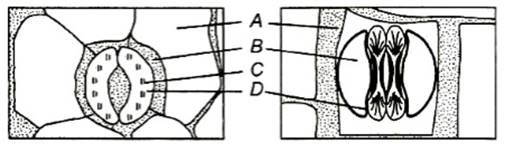
4 pointsIdentify A to D in the given diagram and choose the correct option
-
Question 21 of 30
21. Question
4 pointsWhich of the function in the given options does not belongs to the monocot root?
-
Question 22 of 30
22. Question
4 pointsPeriderm is produced from
-
Question 23 of 30
23. Question
4 pointsThe activity of cambium in plants is under the control of
-
Question 24 of 30
24. Question
4 pointsIn old trees, the greater part of secondary xylem is dark brown due to the
-
Question 25 of 30
25. Question
4 pointsRoots apical meristem occupies the …A… of roots, while shoot apical meristem occupies the distant most region of the …B… axis
Complete the above sentence with the correct combination of A and B -
Question 26 of 30
26. Question
4 pointsExchange of gases between the outer atmosphere and internal tissue of the stem takes place by (in dicot stem)
-
Question 27 of 30
27. Question
4 pointsAll the following statements regarding sieve tube elements are true except
-
Question 28 of 30
28. Question
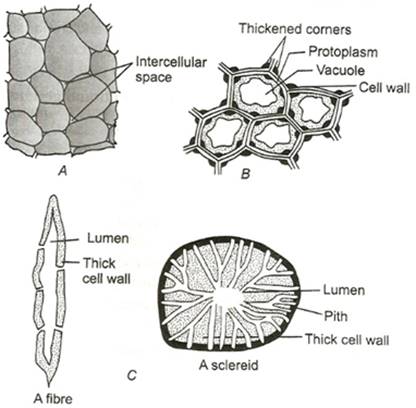
4 pointsIdentify the types of simple tissue given in the diagram A, B and C
-
Question 29 of 30
29. Question
4 pointsThe layer of cells outside the phloem meant for giving rise to the root branches is called
-
Question 30 of 30
30. Question
4 pointsDIRECTIONS: Each of these questions contains an assertion followed by reason. Read them carefully and answer the question on the basis of following options. You have to select the one that best describes the two statements.
Assertion The upper surface of the leaf is darker than the lower surface.
Reason Spongy mesophyll contains less chloroplasts than palisade mesophyll cells.
