
Chapter: Biological Classification – Mock Test -Level 3
0 of 30 questions completed
Questions:
- 1
- 2
- 3
- 4
- 5
- 6
- 7
- 8
- 9
- 10
- 11
- 12
- 13
- 14
- 15
- 16
- 17
- 18
- 19
- 20
- 21
- 22
- 23
- 24
- 25
- 26
- 27
- 28
- 29
- 30
Information
Subject: Biology
Syllabus: Biological Classification
Duration: 30 min.
Read the following instruction carefully.
- There are 30 total questions in this test
- Each question has 4 options out of which only one is correct.
- You will be awarded 4 points for each correct answer and 1 point will be deducted for each wrong answer.
- Try not to guess the answer as there is negative marking.
- Your Score & Rank will be shown after submitting the test.
- In this quiz you are going to check your conceptual knowledge.
You have already completed the Test before. Hence you can not start it again.
Test is loading...
You must sign in or sign up to start the Test.
You have to finish following quiz, to start this Test:
Your results are here!! for" 23_Mock_Neet_Bio_L3_Chapter 2 : Biological Classification "
0 of 30 questions answered correctly
Your time:
Time has elapsed
Your Final Score is : 0
You have attempted : 0
Number of Correct Questions : 0 and scored 0
Number of Incorrect Questions : 0 and Negative marks 0
| Average score |
|
| Your score |
|
-
Not categorized
You have attempted: 0
Number of Correct Questions: 0 and scored 0
Number of Incorrect Questions: 0 and Negative marks 0
-
Level 3
You have attempted: 0
Number of Correct Questions: 0 and scored 0
Number of Incorrect Questions: 0 and Negative marks 0
-
Dear $form{0} you have completed this test.
| Pos. | Name | Entered on | Points | Result |
|---|---|---|---|---|
| Table is loading | ||||
| No data available | ||||
- 1
- 2
- 3
- 4
- 5
- 6
- 7
- 8
- 9
- 10
- 11
- 12
- 13
- 14
- 15
- 16
- 17
- 18
- 19
- 20
- 21
- 22
- 23
- 24
- 25
- 26
- 27
- 28
- 29
- 30
- Answered
- Review
-
Question 1 of 30
1. Question
4 pointsOsmoregulation in Paramecium is a function of
-
Question 2 of 30
2. Question
4 pointsThe genetic material of rabies virus is
-
Question 3 of 30
3. Question
4 pointsThe disease caused by virus which is 42 nm in size and contains double stranded DNA is
-
Question 4 of 30
4. Question
4 pointsIn which animal, dimorphic nucleus us found?
-
Question 5 of 30
5. Question
4 pointsThe given statements describes a group of organism
I. Instead of a cell wall, they have a protein rich layer called pellicle which makes their body flexible
II. They have two flagella a short and a long one
III. They are photosynthetic in the presence of sunlight, when deprived of sunlight they behave like heterotrophs by predating on other smaller organism
Which of the following group is referred here? -
Question 6 of 30
6. Question
4 pointsThe sexual stages of pathogens of blast of rice and red rot of sugarcane are named respectively as
-
Question 7 of 30
7. Question
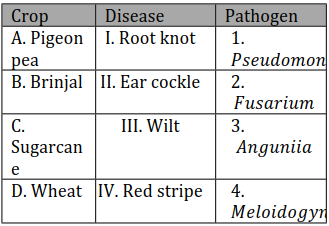
4 pointsIn the table below, some of the crop plants, their diseases and the pathogens are given. Match the three columns and identify the correct choice.
-
Question 8 of 30
8. Question
4 pointsMention the ‘Incubation Period’ of Plasmodium viva.
-
Question 9 of 30
9. Question
4 pointsConsider the following statements
I. All prokaryotic organism were grouped together under kingdom-Monera
II. The unicellular eukaryotic organism were placed in kingdom-Protista
III. Chlorella Chlamydomonas, both were having cell walls
IV. Paramecium and Amoeba lack cell walls
V. Kingdom-Protista has brought together Chlamydomona Chlorella, with Paramecium and Amoeba.
Which of the statements give above are correct? -
Question 10 of 30
10. Question
4 pointsWhich of the following is correct matched?
-
Question 11 of 30
11. Question
4 pointsWhich of these best describes the saprophytic generation in plant’s life cycle
-
Question 12 of 30
12. Question
4 pointsSelect incorrect pair.
-
Question 13 of 30
13. Question
4 pointsCuring of tea is brought about by the activity of
-
Question 14 of 30
14. Question
4 pointsConsider the following statements and place them into true and false category
I. The fungi constitutes a unique kingdom of heterotrophic organisms
II. The common mushroom and toad stools are fungi
IIII. White spots seen on mustard leaves are due to presence of parasitic fungus
IV. Some unicellular fungi(Ustilago) are used to make bread and beer
V. Puccinia is responsible for yellow rust of wheat
VI. Penicillium yields the antibiotic penicillin -
Question 15 of 30
15. Question
4 pointsConsider the following statementsI. Fruce discovered that the parasite of sleeping sickness is transmitted by tse-tse fly
II. Sleeping sickness of Trypanosoma gambiens is also called Gambian trypanoomiasis, which is found in western and central parts of Africa
III. Trichomonas vaginalis inhabits vagina of women and causes the disease leucorrhoea
IV. Entamoeba histolytica resides in the upper part of the human large intestine and cause the disease known as amoebic dysentery
Which of the statements given above are correct? -
Question 16 of 30
16. Question
4 pointsIn the following table, identify the correct matching of the crop, its disease and the corresponding pathogen.
Crop Disease Pathogen (a) Citrus Canker Pseudomonas rubrilineans (b) Potato Late blight Fusarium udum (c) Brinjal Root knot Meloidogyme incognita (d) Pigeon pea Seed gall Phytophthora infestans -
Question 17 of 30
17. Question
4 pointsHow many of following enlisted are correct about plantae-
I. Cells have eukaryotic structure
II. Prominent chloroplast
III. Cellulosic cell wall
IV. Life cycle has three distinct phase
V. Show alteration of generation -
Question 18 of 30
18. Question
4 points“Fire algae” belongs to group –
-
Question 19 of 30
19. Question
4 pointsToxins (Saxitoxins) secreted by some dinoflagellates enter the body of human beings through food chain and result in –
-
Question 20 of 30
20. Question
4 pointsMixotrophic nutrition occurs in :
-
Question 21 of 30
21. Question
4 pointsParaflagellate body of Euglena helps in :
-
Question 22 of 30
22. Question
4 pointsThe photosynthetic protists are :
-
Question 23 of 30
23. Question
4 pointsA colourless dinoflagellate which is also classified as protozoa –
-
Question 24 of 30
24. Question
4 pointsT. O. Diener discovered a new infectious agent that was smaller than viruses and have the following characteristics.
(i) It causes potato spindle tuber disease.
(ii) It has free RNA.
(iii) Molecular weight of RNA is low.
Identify the infections agent. -
Question 25 of 30
25. Question
4 pointsMatch the terms given in column-I with their examples given in column-II and choose the correct option
Column-I Column-II
(Terms) (Examples)
A. Ascus I. Spirulina
B. Basidium II. Penicillium
C. Protista III. Agaricus
D. Cyanobacteria IV. Euglena
E. Animalia V. Sponges -
Question 26 of 30
26. Question
4 pointsWhich of the following groups of protozoan is not correctly matched with its feature?
-
Question 27 of 30
27. Question
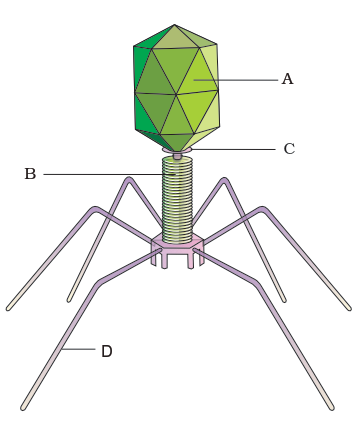
4 pointsThe figure given below shows the structure of a bacteriophage. Identify its parts labelled as A, B, C and D.
-
Question 28 of 30
28. Question
4 pointsA specimen of fungus is brought by a student foridentification. Upon close examination, he discovered that its hyphae are completely septate and it has gills on the underside of the pileus. To which fungal group does it most likely belong ?
-
Question 29 of 30
29. Question
4 pointsHow many bacteria are produced in four hours if a bacterium divides once in half an hour ?
-
Question 30 of 30
30. Question
4 pointsDIRECTIONS: Each of these questions contains an assertion followed by reason. Read them carefully and answer the question on the basis of following options. You have to select the one that best describes the two statements.
Assertion Yeasts such as Saccharomyces cerevisiaeare used in baking industry.
Reason Carbon dioxide produced during fermentation causes bread dough to rise by thermal expansion.
