
Chapter: Body Fluids and Circulation
0 of 76 questions completed
Questions:
- 1
- 2
- 3
- 4
- 5
- 6
- 7
- 8
- 9
- 10
- 11
- 12
- 13
- 14
- 15
- 16
- 17
- 18
- 19
- 20
- 21
- 22
- 23
- 24
- 25
- 26
- 27
- 28
- 29
- 30
- 31
- 32
- 33
- 34
- 35
- 36
- 37
- 38
- 39
- 40
- 41
- 42
- 43
- 44
- 45
- 46
- 47
- 48
- 49
- 50
- 51
- 52
- 53
- 54
- 55
- 56
- 57
- 58
- 59
- 60
- 61
- 62
- 63
- 64
- 65
- 66
- 67
- 68
- 69
- 70
- 71
- 72
- 73
- 74
- 75
- 76
Information
Subject: Biology
Syllabus: Body Fluids and Circulation
Duration: 45 min.
Read the following instruction carefully.
- There are 50 total questions in this test
- Each question has 4 options out of which only one is correct.
- You will be awarded 4 points for each correct answer and 1 point will be deducted for each wrong answer.
- Try not to guess the answer as there is negative marking.
- Your Score & Rank will be shown after submitting the test.
- In this quiz you are going to check your conceptual knowledge.
You have already completed the Test before. Hence you can not start it again.
Test is loading...
You must sign in or sign up to start the Test.
You have to finish following quiz, to start this Test:
Your results are here!! for" NPY_11_Bio_18_18_Body Fluids and Circulation "
0 of 76 questions answered correctly
Your time:
Time has elapsed
Your Final Score is : 0
You have attempted : 0
Number of Correct Questions : 0 and scored 0
Number of Incorrect Questions : 0 and Negative marks 0
| Average score |
|
| Your score |
|
-
Level 1
You have attempted: 0
Number of Correct Questions: 0 and scored 0
Number of Incorrect Questions: 0 and Negative marks 0
-
Dear $form{0} you have completed this test.
| Pos. | Name | Entered on | Points | Result |
|---|---|---|---|---|
| Table is loading | ||||
| No data available | ||||
- 1
- 2
- 3
- 4
- 5
- 6
- 7
- 8
- 9
- 10
- 11
- 12
- 13
- 14
- 15
- 16
- 17
- 18
- 19
- 20
- 21
- 22
- 23
- 24
- 25
- 26
- 27
- 28
- 29
- 30
- 31
- 32
- 33
- 34
- 35
- 36
- 37
- 38
- 39
- 40
- 41
- 42
- 43
- 44
- 45
- 46
- 47
- 48
- 49
- 50
- 51
- 52
- 53
- 54
- 55
- 56
- 57
- 58
- 59
- 60
- 61
- 62
- 63
- 64
- 65
- 66
- 67
- 68
- 69
- 70
- 71
- 72
- 73
- 74
- 75
- 76
- Answered
- Review
-
Question 1 of 76
1. Question
4 pointsPersons with ‘AB’ blood group are called as “universal recipients”. This is due to
-
Question 2 of 76
2. Question
4 pointsWhich enzyme is responsible for the conversion of inactive fibrinogens to fibrins?
-
Question 3 of 76
3. Question
4 pointsMatch the following columns and select the correct option.
Column I Column II
A. Eosinophils 1. Immune response
B. Basophils 2. Phagocytosis
C. Neutrophils 3. Release histaminase destructive enzymes
D. Lymphocytes 4. Release granules containing histamine -
Question 4 of 76
4. Question
4 pointsWhich of the following gastric cells indirectly help in erythropoiesis?
-
Question 5 of 76
5. Question
4 pointsMatch the items given in Column I with those in Column II and select the correct option given below
Column I Column II
1. Fibrinogen (i) Osmotic balance
2. Globulin (ii) Blood clotting
3. Albumin (iii) Defense mechanism -
Question 6 of 76
6. Question
4 pointsAdult human RBCs are enucleate. Which of the following statement(s) is/are most appropriate explanation for this feature?
(I) They do not need to reproduce.
(II) They are somatic cells.
(III) They do not metabolise.
(IV) All their internal space is available for oxygen transport. -
Question 7 of 76
7. Question
4 pointsName the blood cells, whose reduction in number can cause clotting disorder, leading to excessive loss of blood from the body.
-
Question 8 of 76
8. Question
4 pointsSerum differs from blood in
-
Question 9 of 76
9. Question
4 pointsPerson with blood group AB is considered as universal recipient because he has
-
Question 10 of 76
10. Question
4 pointsA certain road accident patient with unknown blood group needs immediate blood transfusion. His one doctor friend at once offers his blood. What was the blood group of the donor?
-
Question 11 of 76
11. Question
4 pointsWhich one of the following plasma proteins is involved in the coagulation of blood?
-
Question 12 of 76
12. Question
4 pointsA person with unknown blood group under ABO system, has suffered much blood loss in an accident and needs immediate blood transfusion. His one friend who has a valid certificate of his own blood type, offers for blood donation without delay. What would have been the type of blood group of the donor friend?
-
Question 13 of 76
13. Question
4 pointsThe most popularly known blood grouping is the ABO grouping. It is named ABO and not ABC because ‘O’ in it refers to having
-
Question 14 of 76
14. Question
4 pointsIf you suspect major deficiency of antibodies in a person, to which of the following would you look for confirmatory evidence?
-
Question 15 of 76
15. Question
4 pointsA drop of each of the following, is placed separately on four slides. Which of them will not coagulate?
-
Question 16 of 76
16. Question
4 pointsExamination of blood of a person suspected of having anaemia, shows large, immature, nucleated erythrocytes without haemoglobin. Supplementing his diet with which of the following, is likely to alleviate his symptoms?
-
Question 17 of 76
17. Question
4 pointsAntibodies in our body are complex
-
Question 18 of 76
18. Question
4 pointsWhich of the following substances, if introduced in the blood stream, would cause coagulation, at the site of its introduction?
-
Question 19 of 76
19. Question
4 pointsYou are required to draw blood from a patient and to keep it in a test tube for analysis of blood corpuscles and plasma. You are also provided with the following four types of test tubes. Which of them will you not use for the purpose?
-
Question 20 of 76
20. Question
4 pointsWhat is correct regarding leucocytes?
-
Question 21 of 76
21. Question
4 pointsWhat is correct for blood group ‘O’?
-
Question 22 of 76
22. Question
4 pointsHaemoglobin is a type of
-
Question 23 of 76
23. Question
4 pointsWhich is the principal cation in the plasma of the blood?
-
Question 24 of 76
24. Question
4 pointsWhich of the following is agranulocyte?
-
Question 25 of 76
25. Question
4 pointsThe life span of human WBC is approximately
-
Question 26 of 76
26. Question
4 pointsWhich one of the following vertebrate organs receives the oxygenated blood only?
-
Question 27 of 76
27. Question
4 pointsAntigens are present
-
Question 28 of 76
28. Question
4 pointsCells formed in bone marrow include
-
Question 29 of 76
29. Question
4 pointsRemoval of calcium from freshly collected blood would
-
Question 30 of 76
30. Question
4 pointsIn the ABO system of blood groups, if both antigens are present but no antibody, the blood group of the individual would be
-
Question 31 of 76
31. Question
4 pointsA person with blood group A requires blood. The blood group which can be given is
-
Question 32 of 76
32. Question
4 pointsWhich one engulfs pathogens rapidly?
-
Question 33 of 76
33. Question
4 pointsChild death may occur in the marriage of
-
Question 34 of 76
34. Question
4 pointsRBCs do not occur in
-
Question 35 of 76
35. Question
4 pointsBreakdown product of haemoglobin is
-
Question 36 of 76
36. Question
4 pointsOne of the factors required for the maturation of erythrocytes is
-
Question 37 of 76
37. Question
4 pointsThe haemorrhagic disease of new born is caused due to the deficiency of
-
Question 38 of 76
38. Question
4 pointsVitamin-K is required for
-
Question 39 of 76
39. Question
4 pointsThe QRS complex in a standard ECG represents
-
Question 40 of 76
40. Question
4 pointsAll the components of the nodal tissue are autoexcitable. Why does the SA node act as the normal pacemaker?
-
Question 41 of 76
41. Question
4 pointsA specialised nodal tissue embedded in the lower corner of the right atrium, close to atrio-ventricular septum, delays the spreading of impulses to heart apex for about 0.1 sec. The delay allows
-
Question 42 of 76
42. Question
4 pointsWhat would be the heart rate of a person if the cardiac output is 5 L, blood volume in the ventricles at the end of diastole is 100 mL and at the end of ventricular systole is 50 mL?
-
Question 43 of 76
43. Question
4 pointsMatch the following columns.
Column I Column II
A. P – wave (i) Depolarisation of ventricles
B. QRS complex (ii) Repolarisation of ventricles
C. T-wave (iii) Coronary ischemia
D. Reduction in the Size of T-wave (iv) Depolarisation of atria
. (v) Repolarisation of atria -
Question 44 of 76
44. Question
4 pointsMatch the items given in Column I with those in Column II and select the correct option given below
Column I Column II
1. Tricuspid valve (i) Between left atrium and left ventricle
2. Bicuspid valve (ii) Between right ventricle and pulmonary artery
3. Semilunar valve (iii) Between right atrium and right ventricle
-
Question 45 of 76
45. Question
4 pointsDoctors use stethoscope to hear the sounds produced during each cardiac cycle. The second sound is heard when
-
Question 46 of 76
46. Question
4 pointsWhich one of the following animals has two separate circulatory pathways?
-
Question 47 of 76
47. Question
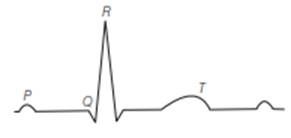
4 pointsThe diagram given here is the standard ECG of a normal person. The P-wave represents the
-
Question 48 of 76
48. Question
4 points‘Bundle of His’ is a part of which one of the following organs in humans?
-
Question 49 of 76
49. Question
4 pointsIf due to some injury the chordae tendinae of the tricuspid valve of the human heart is partially non-functional, what will be the immediate effect?
-
Question 50 of 76
50. Question
4 pointsIn humans, blood passes from the post caval to the diastolic right atrium of heart due to
-
Question 51 of 76
51. Question
4 pointsSystemic heart refers to
-
Question 52 of 76
52. Question
4 pointsBundle of His is a network of
-
Question 53 of 76
53. Question
4 pointsIn mammals, histamine is secreted by
-
Question 54 of 76
54. Question
4 pointsThe correct route through which pulse-making impulse travels in the heart is
-
Question 55 of 76
55. Question
4 pointsPacemaker of heart is
-
Question 56 of 76
56. Question
4 pointsDup sound is produced during closure of
-
Question 57 of 76
57. Question
4 pointsTricuspid valve is found in between
-
Question 58 of 76
58. Question
4 pointsBlood pressure in the pulmonary artery is
-
Question 59 of 76
59. Question
4 pointsIn mammals, which blood vessel would normally carry largest amount of urea?
-
Question 60 of 76
60. Question
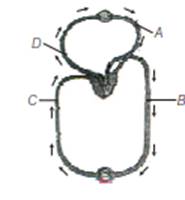
4 pointsFigure shows schematic plan of blood circulation in human with labels A-D. Identify the correct label with given function
-
Question 61 of 76
61. Question
4 pointsArteries are best defined as the vessels which
-
Question 62 of 76
62. Question
4 pointsWhich one of the following statements is correct regarding blood pressure?
-
Question 63 of 76
63. Question
4 pointsPulmonary artery is different from pulmonary vein because it has
-
Question 64 of 76
64. Question
4 pointsThe thickening of walls of arteries is called
-
Question 65 of 76
65. Question
4 pointsAn adult human with average health has systolic and diastolic pressures as
-
Question 66 of 76
66. Question
4 pointsClosed circulatory system occurs in
-
Question 67 of 76
67. Question
4 pointsWall of blood capillary is formed of
-
Question 68 of 76
68. Question
4 pointsSplenic artery arises from
-
Question 69 of 76
69. Question
4 pointsA vein possesses a large lumen because
-
Question 70 of 76
70. Question
4 pointsArteries carry oxygenated blood except
-
Question 71 of 76
71. Question
4 pointsWhich of the following statements is true for lymph?
-
Question 72 of 76
72. Question
4 pointsWhich of the following is not main function of lymph glands?
-
Question 73 of 76
73. Question
4 pointsThe lymph serves to
-
Question 74 of 76
74. Question
4 pointsWhich of the following conditions causes erythroblastosis foetalis?
-
Question 75 of 76
75. Question
4 pointsContinuous bleeding from an injured part of body is due to deficiency of
-
Question 76 of 76
76. Question
4 pointsThe blood cancer is known as
