
Chapter: Cell Cycle and Cell Division
0 of 64 questions completed
Questions:
- 1
- 2
- 3
- 4
- 5
- 6
- 7
- 8
- 9
- 10
- 11
- 12
- 13
- 14
- 15
- 16
- 17
- 18
- 19
- 20
- 21
- 22
- 23
- 24
- 25
- 26
- 27
- 28
- 29
- 30
- 31
- 32
- 33
- 34
- 35
- 36
- 37
- 38
- 39
- 40
- 41
- 42
- 43
- 44
- 45
- 46
- 47
- 48
- 49
- 50
- 51
- 52
- 53
- 54
- 55
- 56
- 57
- 58
- 59
- 60
- 61
- 62
- 63
- 64
Information
Subject: Biology
Syllabus: Cell Cycle and Cell Division
Duration: 45 min.
Read the following instruction carefully.
- There are 64 total questions in this test
- Each question has 4 options out of which only one is correct.
- You will be awarded 4 points for each correct answer and 1 point will be deducted for each wrong answer.
- Try not to guess the answer as there is negative marking.
- Your Score & Rank will be shown after submitting the test.
- In this quiz you are going to check your conceptual knowledge.
You have already completed the Test before. Hence you can not start it again.
Test is loading...
You must sign in or sign up to start the Test.
You have to finish following quiz, to start this Test:
Your results are here!! for" NPY_11_Bio_10_10_Cell Cycle and Cell Division "
0 of 64 questions answered correctly
Your time:
Time has elapsed
Your Final Score is : 0
You have attempted : 0
Number of Correct Questions : 0 and scored 0
Number of Incorrect Questions : 0 and Negative marks 0
| Average score |
|
| Your score |
|
-
Level 1
You have attempted: 0
Number of Correct Questions: 0 and scored 0
Number of Incorrect Questions: 0 and Negative marks 0
-
Dear $form{0} you have completed this test.
| Pos. | Name | Entered on | Points | Result |
|---|---|---|---|---|
| Table is loading | ||||
| No data available | ||||
- 1
- 2
- 3
- 4
- 5
- 6
- 7
- 8
- 9
- 10
- 11
- 12
- 13
- 14
- 15
- 16
- 17
- 18
- 19
- 20
- 21
- 22
- 23
- 24
- 25
- 26
- 27
- 28
- 29
- 30
- 31
- 32
- 33
- 34
- 35
- 36
- 37
- 38
- 39
- 40
- 41
- 42
- 43
- 44
- 45
- 46
- 47
- 48
- 49
- 50
- 51
- 52
- 53
- 54
- 55
- 56
- 57
- 58
- 59
- 60
- 61
- 62
- 63
- 64
- Answered
- Review
-
Question 1 of 64
1. Question
4 pointsThe centriole undergoes duplication during
-
Question 2 of 64
2. Question
4 pointsMatch the List-I with List-II.
List-I List-II
A. S-phase 1. Proteins are synthesised
B. G2 -phase 2. Inactive phase
C. Quiescent stage 3. Interval between mitosis and initiation of DNA replication
D. G1 -phase 4. DNA replication
Choose the correct answer from the options given below. -
Question 3 of 64
3. Question
4 pointsAttachment of spindle fibres to kinetochores of chromosomes becomes evident in
-
Question 4 of 64
4. Question
4 pointsIdentify the correct statement with regard to G1 -phase (Gap 1) of interphase.
-
Question 5 of 64
5. Question
4 pointsSome dividing cells exist the cell cycle and enter vegetative inactive stage. This is called quiescent stage (G0 ). This process occurs at the end of
-
Question 6 of 64
6. Question
4 pointsCells in G0 phase
-
Question 7 of 64
7. Question
4 pointsThe correct sequence of phases of cell cycle is
-
Question 8 of 64
8. Question
4 pointsWhen cell has stalled DNA replication fork, which checkpoint should be predominantly activated?
-
Question 9 of 64
9. Question
4 pointsDuring cell growth, DNA synthesis takes place in
-
Question 10 of 64
10. Question
4 pointsDuring which phase(s) of cell cycle, amount of DNA in a cell remains at 4C level if the initial amount is denoted as 2C?
-
Question 11 of 64
11. Question
4 pointsIn S-phase of the cell cycle
-
Question 12 of 64
12. Question
4 pointsGiven below is a schematic break-up of the phases/stages of cell cycle
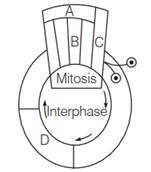
Which one of the following is the correct indication of the stage/phase in the cell cycle? -
Question 13 of 64
13. Question
4 pointsAt what stage of the cell cycle are histone proteins synthesised in a eukaryotic cell?
-
Question 14 of 64
14. Question
4 pointsIn the somatic cell cycle
-
Question 15 of 64
15. Question
4 pointsWhich of the following occurs more than one and less than five in a chromosome?
-
Question 16 of 64
16. Question
4 pointsDuring cell division in apical meristem the nuclear membrane appears in
-
Question 17 of 64
17. Question
4 pointsThe fruit fly has 8 chromosomes (2n) in each cell. During interphase of mitosis, if the number of chromosomes at G1 -phase is 8, what would be the number of chromosomes after S-phase ?
-
Question 18 of 64
18. Question
4 pointsIn a mitotic cycle, the correct sequence of phases is
-
Question 19 of 64
19. Question
4 pointsMatch the following (Columns) events that occur in their respective phases of cell cycle and select the correct option from the codes given below.
Column I Column II
A. G1 -phase 1. Cell grows and organelle duplication
B. S phase 2. DNA replication and chromosome duplication
C. G2 -phase 3. Cytoplasmic growth
D. Metaphase in M-phase 4. Alignment of chromosomes -
Question 20 of 64
20. Question
4 pointsAfter karyogamy followed by meiosis, spores are produced exogenously in
-
Question 21 of 64
21. Question
4 pointsAnaphase Promoting Complex (APC) is a protein degradation machinery necessary for proper mitosis of animals cells. If APC is defective in a human cells, which of the following is expected to occur?
-
Question 22 of 64
22. Question
4 pointsWhich of the following options gives the correct sequences of events during mitosis ?
-
Question 23 of 64
23. Question
4 pointsWhich of the following is not a characteristic feature during mitosis in somatic cells?
-
Question 24 of 64
24. Question
4 pointsSpindle fibres attach on to
-
Question 25 of 64
25. Question
4 pointsThe complex formed by a pair of synapsed homologous chromosomes is called
-
Question 26 of 64
26. Question
4 pointsA stage in cell division is shown in the figure. Select the answer which gives correct identification of the stage with its characteristic mentioned.
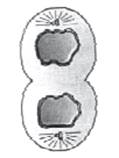
-
Question 27 of 64
27. Question
4 pointsSelect the correct option with respect to mitosis.
-
Question 28 of 64
28. Question
4 pointsDuring mitosis ER and nucleolus begin to disappear at
-
Question 29 of 64
29. Question
4 pointsWhich stages of cell division do the following figures A and B represent respectively?
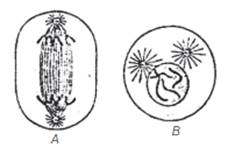
-
Question 30 of 64
30. Question
4 pointsCentromere is required for
-
Question 31 of 64
31. Question
4 pointsIf you are provided with root tips of onion in your class and are asked to count the chromosomes which of the following stages can you most conveniently look into?
-
Question 32 of 64
32. Question
4 pointsWhich one of the following precedes reformation of the nuclear envelope during M-phaseof the cell cycle?
-
Question 33 of 64
33. Question
4 pointsMitotic spindle is mainly composed of which protein?
-
Question 34 of 64
34. Question
4 pointsBest material for the study of mitosis in laboratory is
-
Question 35 of 64
35. Question
4 pointsDuring cell division, the spindle fibres attach to the chromosome at a region called
-
Question 36 of 64
36. Question
4 pointsHow many mitotic divisions are needed for a single cell to make 128 cells?
-
Question 37 of 64
37. Question
4 pointsWhich one of the following structures will not be common to mitotic cells of higher plants?
-
Question 38 of 64
38. Question
4 pointsThe point, at which polytene chromosomes appear to be attached together, is called
-
Question 39 of 64
39. Question
4 pointsBest stage to observe shape, size and number of chromosomes is
-
Question 40 of 64
40. Question
4 pointsIn salivary gland chromosomes/polytene chromosomes pairing is
-
Question 41 of 64
41. Question
4 pointsNumber of chromatids at metaphase is
-
Question 42 of 64
42. Question
4 pointsMitotic anaphase differs from metaphase in possessing
-
Question 43 of 64
43. Question
4 pointsA bivalent consists of
-
Question 44 of 64
44. Question
4 pointsWhich stage of meiotic prophase shows terminalisation of chiasmata as its distinctive feature?
-
Question 45 of 64
45. Question
4 pointsWhich of the following stages of meiosis involves division of centromere?
-
Question 46 of 64
46. Question
4 pointsDuring meiosis 1, in which stage synapsis takes place?
-
Question 47 of 64
47. Question
4 pointsDissolution of the synaptonemal complex occurs during
-
Question 48 of 64
48. Question
4 pointsMatch the following columns with respect to meiosis.
Column I Column II
A. Zygotene 1. Terminalisation
B. Pachytene 2. Chiasmata
C. Diplotene 3. Crossing over
D. Diakinesis 4. Synapsis
Select the correct option. -
Question 49 of 64
49. Question
4 pointsAfter meiosis-I, the resultant daughter cells have
-
Question 50 of 64
50. Question
4 pointsIn meiosis crossing over is initiated at
-
Question 51 of 64
51. Question
4 pointsMatch the stages of meiosis in column I to their characteristic features in column II and select the correct option using the codes given below
Column I Column II
A. Pachytene 1. Pairing of homologous chromosomes
B. Metaphase-I 2. Terminalisation of chiasmata
C. Diakinesis 3. Crossing-over takes place
D. Zygotene 4. Chromosomes align at equatorial plate -
Question 52 of 64
52. Question
4 pointsArrange the following events of meiosis in correct sequences.
I. Crossing over
II. Synapsis
III. Terminalisation of chiasmata
IV. Disapperance of nucleolus -
Question 53 of 64
53. Question
4 pointsThe enzyme recombinase is required at which stage of meiosis?
-
Question 54 of 64
54. Question
4 pointsMeiosis takes place in
-
Question 55 of 64
55. Question
4 pointsDuring gamete formation, the enzyme recombinase participates during
-
Question 56 of 64
56. Question
4 pointsGiven below is the representation of a certain event at a particular stage of a type of cell division.
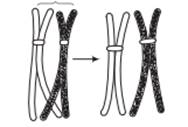
Which is this stage?
-
Question 57 of 64
57. Question
4 pointsSynapsis occurs between
-
Question 58 of 64
58. Question
4 pointsCrossing over that results in genetic recombination in higher organisms occur between
-
Question 59 of 64
59. Question
4 pointsThe exchange of genetic material between chromatids of paired homologous chromosomes during first meiotic division is called
-
Question 60 of 64
60. Question
4 pointsLampbrush chromosomes occur during
-
Question 61 of 64
61. Question
4 pointsMeiosis has evolutionary significance because it results in
-
Question 62 of 64
62. Question
4 pointsMeiosis-II performs
-
Question 63 of 64
63. Question
4 pointsIn meiosis, the daughter cells differ from parent cell as well as amongst themselves due to
-
Question 64 of 64
64. Question
4 pointsMeiosis-I is reductional division. Meiosis-II is equational division due to
