
Chapter: Organisms and Population
0 of 88 questions completed
Questions:
- 1
- 2
- 3
- 4
- 5
- 6
- 7
- 8
- 9
- 10
- 11
- 12
- 13
- 14
- 15
- 16
- 17
- 18
- 19
- 20
- 21
- 22
- 23
- 24
- 25
- 26
- 27
- 28
- 29
- 30
- 31
- 32
- 33
- 34
- 35
- 36
- 37
- 38
- 39
- 40
- 41
- 42
- 43
- 44
- 45
- 46
- 47
- 48
- 49
- 50
- 51
- 52
- 53
- 54
- 55
- 56
- 57
- 58
- 59
- 60
- 61
- 62
- 63
- 64
- 65
- 66
- 67
- 68
- 69
- 70
- 71
- 72
- 73
- 74
- 75
- 76
- 77
- 78
- 79
- 80
- 81
- 82
- 83
- 84
- 85
- 86
- 87
- 88
Information
Subject: Biology
Syllabus: Organisms and Population
Duration: 1 Hr.
Read the following instruction carefully.
- There are 88 total questions in this test
- Each question has 4 options out of which only one is correct.
- You will be awarded 4 points for each correct answer and 1 point will be deducted for each wrong answer.
- Try not to guess the answer as there is negative marking.
- Your Score & Rank will be shown after submitting the test.
- In this quiz you are going to check your conceptual knowledge.
You have already completed the Test before. Hence you can not start it again.
Test is loading...
You must sign in or sign up to start the Test.
You have to finish following quiz, to start this Test:
Your results are here!! for" NPY_12_Bio_35_13_Organisms and Population "
0 of 88 questions answered correctly
Your time:
Time has elapsed
Your Final Score is : 0
You have attempted : 0
Number of Correct Questions : 0 and scored 0
Number of Incorrect Questions : 0 and Negative marks 0
| Average score |
|
| Your score |
|
-
Not categorized
You have attempted: 0
Number of Correct Questions: 0 and scored 0
Number of Incorrect Questions: 0 and Negative marks 0
-
Level 1
You have attempted: 0
Number of Correct Questions: 0 and scored 0
Number of Incorrect Questions: 0 and Negative marks 0
-
Dear $form{0} you have completed this test.
| Pos. | Name | Entered on | Points | Result |
|---|---|---|---|---|
| Table is loading | ||||
| No data available | ||||
- 1
- 2
- 3
- 4
- 5
- 6
- 7
- 8
- 9
- 10
- 11
- 12
- 13
- 14
- 15
- 16
- 17
- 18
- 19
- 20
- 21
- 22
- 23
- 24
- 25
- 26
- 27
- 28
- 29
- 30
- 31
- 32
- 33
- 34
- 35
- 36
- 37
- 38
- 39
- 40
- 41
- 42
- 43
- 44
- 45
- 46
- 47
- 48
- 49
- 50
- 51
- 52
- 53
- 54
- 55
- 56
- 57
- 58
- 59
- 60
- 61
- 62
- 63
- 64
- 65
- 66
- 67
- 68
- 69
- 70
- 71
- 72
- 73
- 74
- 75
- 76
- 77
- 78
- 79
- 80
- 81
- 82
- 83
- 84
- 85
- 86
- 87
- 88
- Answered
- Review
-
Question 1 of 88
1. Question
4 pointsNiche is
-
Question 2 of 88
2. Question
4 pointsWhich one of the following pairs is mismatched?
-
Question 3 of 88
3. Question
4 pointsKeystone species in an ecosystem are those which
-
Question 4 of 88
4. Question
4 pointsNiche of a species in an ecosystem refers to its
-
Question 5 of 88
5. Question
4 pointsTropical forests occur in India
-
Question 6 of 88
6. Question
4 pointsXeric environment is characterised by
-
Question 7 of 88
7. Question
4 pointsStudy of inter-relationships between living organisms and their environment is
-
Question 8 of 88
8. Question
4 pointsThe sum total of the population of the same kind of organisms constitute
-
Question 9 of 88
9. Question
4 pointsWhat is true for individuals of same species?
-
Question 10 of 88
10. Question
4 pointsWhich part of the world has high density of organisms?
-
Question 11 of 88
11. Question
4 pointsAn association of individuals of different species living in the same habitat and having functional interactions is
-
Question 12 of 88
12. Question
4 pointsCompetition for light, nutrients and space is most severe between
-
Question 13 of 88
13. Question
4 pointsMatch the organisms in Column I with habitats in Column II
Column I Column II
1. Halophiles i. Hot springs
2. Thermoacidophiles ii. Aquatic environment
3. Methanogens iii. Guts of ruminants
4. Cyanobacteria iv. Salty area
Select the correct option from the following -
Question 14 of 88
14. Question
4 pointsIt is much easier for a small animal to run uphill than for a large animal, because
-
Question 15 of 88
15. Question
4 pointsThe figure given below is a diagrammatic representation of response of organisms to abiotic factors. What do (i), (ii) and (iii) represent respectively?
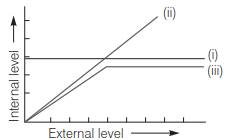
(i) (ii) (iii)
A. Conformer Regulator Partial regulator
B. Regulator Partial regulator Conformer
C. Partial regulator regulator Conformer
D. Regulator Conformer Partial regulatorHint
-
Question 16 of 88
16. Question
4 pointsConsider the following four statements (I-IV) about certain desert animals such as kangaroo rat.
I. They have dark colour and high rate of reproduction and excrete solid urine.
II. They do not drink water, breathe at a slow rate to conserve water and have their body covered with thick hairs.
III. They feed on dry seeds and do not require drinking water.
IV. They excrete very concentrated urine and do not use water to regulate body temperature.
Which two of the above statements for such animals are true? -
Question 17 of 88
17. Question
4 points. Annual migration does not occur in the case of
-
Question 18 of 88
18. Question
4 pointsIn which one of the following pair is the specific characteristic of soil not correctly matched?
-
Question 19 of 88
19. Question
4 pointsIn which one of the following habitats does the diurnal temperature of soil surface vary most?
-
Question 20 of 88
20. Question
4 pointsDiffuse porous woods are characteristic of plants growing in
-
Question 21 of 88
21. Question
4 pointsSpecial kinds of roots called pneumatophores are characteristics of the plants growing in
-
Question 22 of 88
22. Question
4 pointsTemperature changes in the environment affect most of the animals which are
-
Question 23 of 88
23. Question
4 pointsExtremities, tail and ear are relatively shorter in animals living in cooler regions as compared to those inhabiting warmer zones. This is
-
Question 24 of 88
24. Question
4 pointsDesert plants are generally
-
Question 25 of 88
25. Question
4 pointsSunken stomata is the characteristic feature of
-
Question 26 of 88
26. Question
4 pointsWhich of the following does not have stomata?
-
Question 27 of 88
27. Question
4 pointsAnimals that can tolerate a narrow range of salinity are
-
Question 28 of 88
28. Question
4 pointsSoil best suited for plant growth is
-
Question 29 of 88
29. Question
4 pointsSoil particles determine its
-
Question 30 of 88
30. Question
4 pointsA fertile agricultural soil appears dark coloured at the surface as compared to soil one metre down. The reason for colour of top soil is
-
Question 31 of 88
31. Question
4 pointsRiver water deposits
-
Question 32 of 88
32. Question
4 pointsDeep black soil is productive due to high proportion of
-
Question 33 of 88
33. Question
4 pointsCAM helps the plants in
-
Question 34 of 88
34. Question
4 pointsTwo different species cannot live for long duration in the same niche or habitat. This law is
-
Question 35 of 88
35. Question
4 pointsIn which of the following plant sunken stomata are found?
-
Question 36 of 88
36. Question
4 pointsInspite of interspecific competition in nature, which mechanism the competing species might have evolved for their survival ?
-
Question 37 of 88
37. Question
4 pointsIn the exponential growth equation e represents
-
Question 38 of 88
38. Question
4 pointsAmensalism can be represented as
-
Question 39 of 88
39. Question
4 pointsMatch the items in Column I with those in Column II.
Column I Column II
A. Herbivores-Plants (i) Commensalism
B. Mycorrhiza-Plants (ii) Mutualism
C. Sheep-Cattle (iii) Predation
D. Orchid-Tree (iv) Competition
Select the correct option. -
Question 40 of 88
40. Question
4 pointsThe impact of immigration on population density is
-
Question 41 of 88
41. Question
4 pointsAccording to Alexander von Humboldt
-
Question 42 of 88
42. Question
4 pointsWhich of the following is not an attribute of a population?
-
Question 43 of 88
43. Question
4 pointsSecondary metabolites such as nicotine, strychnine and caffeine are produced by plants for their
-
Question 44 of 88
44. Question
4 pointsBetween which among the following, the relationship is not an example of commensalism?
-
Question 45 of 88
45. Question
4 pointsCarnivorous animals-lions and leopards, occupy the same niche but lions predate mostly larger animals and leopards take smaller ones. This mechanism of competition is referred to as
-
Question 46 of 88
46. Question
4 pointsWhich of the following statements is correct?
-
Question 47 of 88
47. Question
4 pointsPinus seed cannot germinate and establish without fungal association. This is because
-
Question 48 of 88
48. Question
4 pointsMatch Column I with Column II.
Column I Column II
A. Saprophyte (i) Symbiotic association of fungi with plant roots
B. Parasite (ii) Decomposition of dead organic materials
C. Lichens (iii) Living on living plants or animals
D. Mycorrhiza (iv) Symbiotic association of algae and fungi.
Choose the correct answer from the option given below: -
Question 49 of 88
49. Question
4 pointsWhich one of the following plants shows a very close relationship with a species of moth, where none of the two can complete its life cycle without the other?
-
Question 50 of 88
50. Question
4 pointsNatality refers to
-
Question 51 of 88
51. Question
4 pointsWhich one of the following population interactions is widely used in medical science for the production of antibiotics?
-
Question 52 of 88
52. Question
4 pointsIn a growing population of a country,
-
Question 53 of 88
53. Question
4 pointsAsymptote in a logistic growth curve is obtained, when
-
Question 54 of 88
54. Question
4 pointsMycorrhizae are the example of
-
Question 55 of 88
55. Question
4 pointsGause’s principle of competitive exclusion states that
-
Question 56 of 88
56. Question
4 pointsWhen does the growth rate of a population following the logistic model equal zero? The logistic model is given as
-
Question 57 of 88
57. Question
4 pointsThe principle of competitive exclusion was stated by
-
Question 58 of 88
58. Question
4 pointsIf ‘+’ sign is assigned to beneficial interaction, ‘–’ sign to detrimental and ‘0’ sign to neutral interaction, then the population interaction represented by ‘+’ ‘–’ refers to
-
Question 59 of 88
59. Question
4 pointsWhich of the following is correct for r-selected species?
-
Question 60 of 88
60. Question
4 pointsIn which of the following interactions both partners are adversely affected?
-
Question 61 of 88
61. Question
4 pointsA biologist studied the population of rats in a barn. He found that the average natality was 250, average mortality 240, immigration 20 and emigration 30. The net increase in population is
-
Question 62 of 88
62. Question
4 pointsA sedentary sea anemone gets attached to the shell lining of hermit crab. The association is
-
Question 63 of 88
63. Question
4 pointsWhat type of human population is represented by the following age pyramid?
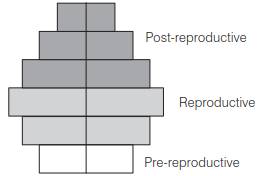
-
Question 64 of 88
64. Question
4 pointsConsider the following four conditions (I-IV) and select a correct pair of them as adaptation to environment in desert lizards.
Conditions
I. Burrowing in soil to escape high temperature.
II. Losing heat rapidly from the body during high temperature.
III. Bask in sun when temperature is low.
IV. Insulating body due to thick fatty dermis. -
Question 65 of 88
65. Question
4 pointsWhich one of the following is categorised as a parasite in true sense?
-
Question 66 of 88
66. Question
4 pointsWhich one of the following is one of the characteristics of a biological community?
-
Question 67 of 88
67. Question
4 pointsA country with a high rate of population growth took measures to reduce it. The figure below shows age sex pyramids of populations. A and B twenty years apart. Select the correct interpretation about them
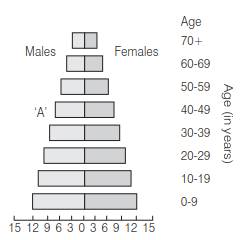
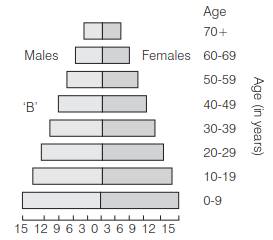
-
Question 68 of 88
68. Question
4 pointsA high density of elephant population in an area can result in
-
Question 69 of 88
69. Question
4 pointsThe population of an insect species shows an explosive increase in numbers during rainy season followed by its disappearance at the end of the season. What does this show?
-
Question 70 of 88
70. Question
4 pointsGeometric representation of age structure is a characteristic of
-
Question 71 of 88
71. Question
4 pointsIf the mean and the median pertaining to a certain character of a population are of the same value, the following is most likely to occur
-
Question 72 of 88
72. Question
4 pointsThe formula for exponential population growth is
-
Question 73 of 88
73. Question
4 pointsNiche overlap indicates
-
Question 74 of 88
74. Question
4 pointsPraying mentis is a good example of
-
Question 75 of 88
75. Question
4 pointsAnimals have the innate ability to escape from predation. Examples for the same are given below.Select the incorrect example
-
Question 76 of 88
76. Question
4 pointsMycorrhiza is an example of
-
Question 77 of 88
77. Question
4 pointsThe semilog of per minute growing bacteria is plotted against ime. What will be the shape of graph?
-
Question 78 of 88
78. Question
4 pointsChoose the correct sequence of stages of growth curve for bacteria
-
Question 79 of 88
79. Question
4 pointsWhich type of association is found in between entomophilous flower and pollinating agent?
-
Question 80 of 88
80. Question
4 pointsWhich of the following is a correct pair?
-
Question 81 of 88
81. Question
4 pointsTwo different species cannot live for long duration in the sameniche or habitat. This law is
-
Question 82 of 88
82. Question
4 pointsAn orchid resembling the female of an insect, so as to be able to get pollinated is due to the phenomenon of
-
Question 83 of 88
83. Question
4 pointsThe concept that population tends to increase geometrically while food supply increases arithmetically was put forward by
-
Question 84 of 88
84. Question
4 pointsWhich of the following pair is correctly matched?
-
Question 85 of 88
85. Question
4 pointsA mutually beneficial association necessary for survival of both partners are
-
Question 86 of 88
86. Question
4 pointsThe relation between algae and fungi in a lichen is
-
Question 87 of 88
87. Question
4 pointsPhenomenon when organisms resembling others for escaping from enemies is
-
Question 88 of 88
88. Question
4 pointsAssociation between sucker fish (Remora) and shark is
