
Chapter: Breathing and Exchange of Gases
0 of 45 questions completed
Questions:
- 1
- 2
- 3
- 4
- 5
- 6
- 7
- 8
- 9
- 10
- 11
- 12
- 13
- 14
- 15
- 16
- 17
- 18
- 19
- 20
- 21
- 22
- 23
- 24
- 25
- 26
- 27
- 28
- 29
- 30
- 31
- 32
- 33
- 34
- 35
- 36
- 37
- 38
- 39
- 40
- 41
- 42
- 43
- 44
- 45
Information
Subject: Biology
Syllabus: Breathing and Exchange of Gases
Duration: 30 min.
Read the following instruction carefully.
- There are 45 total questions in this test
- Each question has 4 options out of which only one is correct.
- You will be awarded 4 points for each correct answer and 1 point will be deducted for each wrong answer.
- Try not to guess the answer as there is negative marking.
- Your Score & Rank will be shown after submitting the test.
- In this quiz you are going to check your conceptual knowledge.
You have already completed the Test before. Hence you can not start it again.
Test is loading...
You must sign in or sign up to start the Test.
You have to finish following quiz, to start this Test:
Your results are here!! for" NPY_11_Bio_17_17_Breathing and Exchange of Gases "
0 of 45 questions answered correctly
Your time:
Time has elapsed
Your Final Score is : 0
You have attempted : 0
Number of Correct Questions : 0 and scored 0
Number of Incorrect Questions : 0 and Negative marks 0
| Average score |
|
| Your score |
|
-
Not categorized
You have attempted: 0
Number of Correct Questions: 0 and scored 0
Number of Incorrect Questions: 0 and Negative marks 0
-
Level 1
You have attempted: 0
Number of Correct Questions: 0 and scored 0
Number of Incorrect Questions: 0 and Negative marks 0
-
Dear $form{0} you have completed this test.
| Pos. | Name | Entered on | Points | Result |
|---|---|---|---|---|
| Table is loading | ||||
| No data available | ||||
- 1
- 2
- 3
- 4
- 5
- 6
- 7
- 8
- 9
- 10
- 11
- 12
- 13
- 14
- 15
- 16
- 17
- 18
- 19
- 20
- 21
- 22
- 23
- 24
- 25
- 26
- 27
- 28
- 29
- 30
- 31
- 32
- 33
- 34
- 35
- 36
- 37
- 38
- 39
- 40
- 41
- 42
- 43
- 44
- 45
- Answered
- Review
-
Question 1 of 45
1. Question
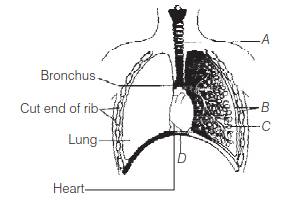
4 pointsThe figure shows a diagrammatic view of human respiratory system with labels A, B, C and D. Select the option, which gives correct identification and main function and/or characteristic.
-
Question 2 of 45
2. Question
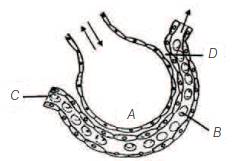
4 pointsThe figure given below shows a small part of human lung where exchange of gas takes place. In which one of the options given below, the one part A, B, C or D is correctly identified along with its function.
-
Question 3 of 45
3. Question
4 pointsWhich one of the following organs in the human body is most affected due to shortage of oxygen?
-
Question 4 of 45
4. Question
4 pointsIn alveoli of the lungs, the air at the site of gas exchange, is separated from the blood by
-
Question 5 of 45
5. Question
4 pointsSelect the correct events that occur during inspiration.
I. Contraction of diaphragm.
II. Contraction of external inter-costal muscles.
III. Pulmonary volume decreases.
IV. Intra pulmonary pressure increases. -
Question 6 of 45
6. Question
4 pointsSelect the correct statement.
-
Question 7 of 45
7. Question
4 pointsAir is breathed through
-
Question 8 of 45
8. Question
4 pointsThe Total Lung Capacity (TLC) is the total volume of air accommodated in the lungs at the end of a forced inspiration. This includes
-
Question 9 of 45
9. Question
4 pointsThe maximum volume of air a person can breathe in after a forced expiration is known as
-
Question 10 of 45
10. Question
4 pointsTidal Volume and Expiratory Reserve Volume of an athlete is 500 mL and 1000 mL, respectively. What will be his Expiratory Capacity if the Residual Volume is 1200 mL?
-
Question 11 of 45
11. Question
4 pointsMatch the items given in Column I with those in Column II and select the correct option given below
Column I Column II
1. Tidal volume (i) 2500–3000 mL
2. Inspiratory reserve volume (ii) 1100–1200 mL
3. Expiratory reserve volume (iii) 500–550 mL
4. Residual volume (iv) 1000–1100 mL -
Question 12 of 45
12. Question
4 pointsLungs are made up of air-filled sacs, the alveoli. They do not collapse even after forceful expiration, because of
-
Question 13 of 45
13. Question
4 pointsLungs do not collapse between breaths and some air always remains in the lungs which can never be expelled because
-
Question 14 of 45
14. Question
4 pointsListed below are four respiratory capacities (1-4) and four jumbled respiratory volumes of a normal human adult respiratory
Respiratory Capacities Volumes
1. Residual volume 2500 mL
2. Vital capacity 3500 mL
3. Inspiratory reserve volume 1200 mL
4. Inspiratory capacity 4500 mL
Which one of the following is the correct matching of two capacities and volumes? -
Question 15 of 45
15. Question
4 pointsWhat is the vital capacity of our lungs?
-
Question 16 of 45
16. Question
4 pointsThe quantity 1500 mL in the respiratory volumes of a normal human adult refers to
-
Question 17 of 45
17. Question
4 pointsAssertion (A) A person goes to high altitude and experiences ‘altitude sickness’ with symptoms like breathing difficulty and heart palpitations.
Reason (R) Due to low atmospheric pressure at high altitude, the body does not get sufficient oxygen.
In the light of the above statements, choose the correct answer from the options given below. -
Question 18 of 45
18. Question
4 pointsSelect the favourable conditions required for the formation of oxyhaemoglobin at the alveoli.
-
Question 19 of 45
19. Question
4 pointsThe partial pressures (in mm Hg) of oxygen (O2 ) and carbon dioxide (CO2 ) at alveoli (the site of diffusion) are
-
Question 20 of 45
20. Question
4 pointsMatch the following columns and select the correct option from the codes given below.
Column I Column II
A. Pneumotaxic centre 1. Alveoli
B. O2 dissociation curve 2. Pons region of brain
C. Carbonic anhydrase 3. Haemoglobin
D. Primary site of exchange of gases 4. RBC -
Question 21 of 45
21. Question
4 pointsIdentify the wrong statement with reference to transport of oxygen.
-
Question 22 of 45
22. Question
4 pointsReduction in pH of blood will
-
Question 23 of 45
23. Question
4 pointsThe partial pressure of oxygen in the alveoli of the lungs is
-
Question 24 of 45
24. Question
4 pointsApproximately seventy percent of carbon dioxide absorbed by the blood will be transported to the lungs
-
Question 25 of 45
25. Question
4 pointsPeople who have migrated from the planes to an area adjoining Rohtang Pass about six months back
-
Question 26 of 45
26. Question
4 pointsWhich two of the following changes (1-4) usually tend to occur in the plain dwellers when they move to high altitudes (3,500 m or more)?
1. Increase in red blood cell size
.2. Increase in red blood cell production
3. Increased breathing rate
4. Increase in thrombocyte count
Changes occurring are -
Question 27 of 45
27. Question
4 pointsThe haemoglobin of a human foetus
-
Question 28 of 45
28. Question
4 pointsPeople living at sea level have around 5 million RBC per cubic millimeter of their blood whereas those living at an altitude of 5400 metre have around 8 million. This is because at high altitude
-
Question 29 of 45
29. Question
4 pointsBlood analysis of a patient reveals an unusually high quantity of carboxyhaemoglobin content. Which of the following conclusions is most likely to be correct?
-
Question 30 of 45
30. Question
4 pointsWhen CO2 concentration in blood increases, breathing becomes
-
Question 31 of 45
31. Question
4 pointsThe process of migration of chloride ions from plasma to RBC and of carbonate ions from RBC to plasma is
-
Question 32 of 45
32. Question
4 pointsThe exchange of gases in the alveoli of the lungs takes place by
-
Question 33 of 45
33. Question
4 pointsWhich one of the following statements about blood constituents and transport of respiratory gases is most accurate?
-
Question 34 of 45
34. Question
4 pointsAt high altitude, the RBCs in the human blood will
-
Question 35 of 45
35. Question
4 pointsThe carbon dioxide is transported via blood to lungs as
-
Question 36 of 45
36. Question
4 pointsAlthough much CO2 is carried in blood, yet blood does not become acidic, because
-
Question 37 of 45
37. Question
4 pointsOxygen dissociation curve of haemoglobin is
-
Question 38 of 45
38. Question
4 pointsCarbon dioxide is transported from tissues to respiratory surface by only
-
Question 39 of 45
39. Question
4 pointsCarbonic anhydrase occurs in
-
Question 40 of 45
40. Question
4 pointsAccording to Central Pollution Control Board (CPCB) what size (in diameter) of particulate is responsible for causing greater harm to human health?
-
Question 41 of 45
41. Question
4 pointsWhich of the following is an occupational respiratory disorder?
-
Question 42 of 45
42. Question
4 pointsWhich one of the following options correctly represents the lung conditions in asthma and emphysema, respectively?
-
Question 43 of 45
43. Question
4 pointsName the chronic respiratory disorder caused mainly by cigarette smoking
-
Question 44 of 45
44. Question
4 pointsName the pulmonary disease in which alveolar surface area involved in gas exchange is drastically reduced due to damage in the alveolar walls.
-
Question 45 of 45
45. Question
4 pointsWhich one of the following is the correct statement for respiration in humans?
