
Chapter: Laws of Motion
0 of 66 questions completed
Questions:
- 1
- 2
- 3
- 4
- 5
- 6
- 7
- 8
- 9
- 10
- 11
- 12
- 13
- 14
- 15
- 16
- 17
- 18
- 19
- 20
- 21
- 22
- 23
- 24
- 25
- 26
- 27
- 28
- 29
- 30
- 31
- 32
- 33
- 34
- 35
- 36
- 37
- 38
- 39
- 40
- 41
- 42
- 43
- 44
- 45
- 46
- 47
- 48
- 49
- 50
- 51
- 52
- 53
- 54
- 55
- 56
- 57
- 58
- 59
- 60
- 61
- 62
- 63
- 64
- 65
- 66
Information
Subject: Physics
Syllabus: Laws of Motion
Duration: 30 min.
Read the following instruction carefully.
- There are 30 total questions in this test
- Each question has 4 options out of which only one is correct.
- You will be awarded 4 points for each correct answer and 1 point will be deducted for each wrong answer.
- Try not to guess the answer as there is negative marking.
- Your Score & Rank will be shown after submitting the test.
- In this quiz you are going to check your conceptual knowledge.
You have already completed the Test before. Hence you can not start it again.
Test is loading...
You must sign in or sign up to start the Test.
You have to finish following quiz, to start this Test:
Your results are here!! for" NPY_11_Phy_04_Laws of Motion "
0 of 66 questions answered correctly
Your time:
Time has elapsed
Your Final Score is : 0
You have attempted : 0
Number of Correct Questions : 0 and scored 0
Number of Incorrect Questions : 0 and Negative marks 0
| Average score |
|
| Your score |
|
-
PYQ
You have attempted: 0
Number of Correct Questions: 0 and scored 0
Number of Incorrect Questions: 0 and Negative marks 0
-
Dear $form{0} you have completed this test.
| Pos. | Name | Entered on | Points | Result |
|---|---|---|---|---|
| Table is loading | ||||
| No data available | ||||
- 1
- 2
- 3
- 4
- 5
- 6
- 7
- 8
- 9
- 10
- 11
- 12
- 13
- 14
- 15
- 16
- 17
- 18
- 19
- 20
- 21
- 22
- 23
- 24
- 25
- 26
- 27
- 28
- 29
- 30
- 31
- 32
- 33
- 34
- 35
- 36
- 37
- 38
- 39
- 40
- 41
- 42
- 43
- 44
- 45
- 46
- 47
- 48
- 49
- 50
- 51
- 52
- 53
- 54
- 55
- 56
- 57
- 58
- 59
- 60
- 61
- 62
- 63
- 64
- 65
- 66
- Answered
- Review
-
Question 1 of 66
1. Question
4 pointsA ball of mass \(\begin{align}0.15\,kg\end{align}\)is dropped from a height \(\begin{align}10\,m\end{align}\), strikes the ground and rebounds to the same height. The magnitude of impulse imparted to the ball is nearly \(\begin{align}(g=10\,m/{{s}^{2}})\end{align}\)
-
Question 2 of 66
2. Question
4 pointsA truck is stationary and has a bob suspended by a light string, in a frame attached to the truck. The truck, suddenly moves to the right with an acceleration of \(\begin{align}a\end{align}\). The pendulum will tilt
-
Question 3 of 66
3. Question
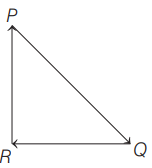
4 pointsA particle moving with velocity \(\begin{align}v\end{align}\) is acted by three forces shown by the vector triangle\(\begin{align}PQR\end{align}\). The velocity of the particle will
-
Question 4 of 66
4. Question
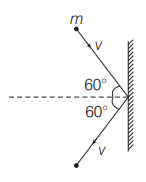
4 pointsA rigid ball of mass \(\begin{align}m\end{align}\) strikes a rigid wall at \(\begin{align}60{}^\circ \end{align}\) and gets reflected without loss of speed as shown in the figure. The value of impulse imparted by the wall on the ball will be
-
Question 5 of 66
5. Question
4 pointsA bullet of mass \(\begin{align}10\,g\end{align}\) moving horizontal with a velocity of \(\begin{align}400\,m/s\end{align}\) strikes a wood block of mass \(\begin{align}2\,kg\end{align}\) which is suspended by light inextensible string of length \(\begin{align}5\,m\end{align}\). As result, the centre of gravity of the block found to rise a vertical distance of \(\begin{align}10cm\end{align}\). The speed of the bullet after it emerges of horizontally from the block will be
-
Question 6 of 66
6. Question
4 pointsThe force \(\begin{align}F\end{align}\) acting on a particle of mass \(\begin{align}m\end{align}\) is indicated by the force-time graph shown below. The change in momentum of the particle over the time interval from \(\begin{align}0\end{align}\) to \(\begin{align}8\end{align}\)\(\begin{align}s\end{align}\)is
-
Question 7 of 66
7. Question
4 pointsA balloon with mass \(\begin{align}m\end{align}\) is descending down with an acceleration \(\begin{align}a(where,\, a<g)\end{align}\). How much mass should be removed from it so that it starts moving up with an acceleration \(\begin{align}a\end{align}\) ?
-
Question 8 of 66
8. Question
4 pointsAn explosion breaks a rock into three parts in a horizontal plane. Two of them go off at right angles to each other. The first part of mass \(\begin{align}1\text{ }kg\end{align}\)moves with a speed of \(\begin{align}12m{{s}^{{-1}}}\end{align}\)and the second part of mass \(\begin{align}2\text{ }kg\end{align}\)moves with \(\begin{align}8\,m{{s}^{{-1}}}\end{align}\)speed. If the third part flies off with \(\begin{align}4\,m{{s}^{{-1}}}\end{align}\)speed, then its mass is
-
Question 9 of 66
9. Question
4 pointsTwo spheres \(\begin{align}A\end{align}\) and \(\begin{align}B\end{align}\)of masses \(\begin{align}{{m}_{1}}\end{align}\) and \(\begin{align}{{m}_{2}}\end{align}\)respectively collide. \(\begin{align}A\end{align}\) is at rest initially and \(\begin{align}B\end{align}\)is moving with velocity \(\begin{align}v\end{align}\) along \(\begin{align}x-axis\end{align}\). After collision, \(\begin{align}B\end{align}\)has a velocity \(\begin{align}\frac{v}{2}\end{align}\) in a direction perpendicular to the original direction. The mass \(\begin{align}A\end{align}\) moves after collision in the direction
-
Question 10 of 66
10. Question
4 pointsA man of \(\begin{align}50\,kg\end{align}\)mass is standing in a gravity free space at a height of \(\begin{align}10\,m\end{align}\) above the floor. He throws a stone of \(\begin{align}0.5\,kg\end{align}\)mass downwards with a speed \(\begin{align}2\,m{{s}^{{-1}}}\end{align}\). When the stone reaches the floor, the distance of the man above the floor will be
-
Question 11 of 66
11. Question
4 pointsA body, under the action of a force \(\begin{align}F=6\overset{\wedge }{\mathop{i}}\,-8\overset{\wedge }{\mathop{j}}\,+10\overset{\wedge }{\mathop{k}}\,\end{align}\),acquires an acceleration of \(\begin{align}1\,m{{s}^{{-2}}}\end{align}\) . The mass of this body must be
-
Question 12 of 66
12. Question
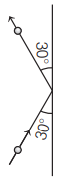
4 pointsA \(\begin{align}0.5\,kg\end{align}\)ball moving with a speed of \(\begin{align}12\,m/s\end{align}\)strikes a hard wall at an angle of \(\begin{align}30{}^\circ \end{align}\) with the wall. It is reflected with the same speed and at the same angle. If the ball is in contact with the wall for \(\begin{align}0.25\text{ }s\end{align}\), the average force acting on the wall is
-
Question 13 of 66
13. Question
4 pointsA block of mass \(\begin{align}m\end{align}\) is placed on a smooth wedge of inclination\(\begin{align}\theta \end{align}\). The whole system is accelerated horizontally, so that the block does not slip on the wedge. The force exerted by the wedge on the block (\(\begin{align}g\end{align}\) is acceleration due to gravity) will be
-
Question 14 of 66
14. Question
4 pointsAn object of mass \(\begin{align}3\,kg\end{align}\) is at rest. If a force \(\begin{align}F=(6{{t}^{2}}\overset{\wedge }{\mathop{i}}\,+4t\overset{\wedge }{\mathop{j}}\,)\end{align}\)\(\begin{align}N\end{align}\) is applied on the object, then the velocity of the object at \(\begin{align}t=3s\end{align}\) is
-
Question 15 of 66
15. Question
4 pointsA player takes \(\begin{align}0.1\,s\end{align}\)in catching a ball of mass \(\begin{align}150g\end{align}\) moving with velocity of \(\begin{align}20\,m/s\end{align}\). The force imparted by the ball on the hands of the player is
-
Question 16 of 66
16. Question
4 points1 kg body explodes into three fragments. The ratio of their masses is \(\begin{align}1:1:3\end{align}\). The fragments of same mass move perpendicular to each other with speeds \(\begin{align}30\,m/s\end{align}\), while the heavier part remains in the initial direction. The speed of heavier part is
-
Question 17 of 66
17. Question
4 pointsA particle of mass \(\begin{align}1\,kg\end{align}\) is thrown vertically upwards with speed \(\begin{align}100\,m/s\end{align}\). After \(\begin{align}5\,s\end{align}\), it explodes into two parts. One part of mass \(\begin{align}400g\end{align}\) comes back with speed \(\begin{align}25\,m/s\end{align}\), what is the speed of other part just after explosion?
-
Question 18 of 66
18. Question
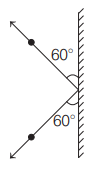
4 pointsA ball of mass \(\begin{align}3\,kg\end{align}\) moving with a speed of \(\begin{align}100\,m/s\end{align}\), strikes a wall at an angle \(\begin{align}60{}^\circ \end{align}\) (as shown in figure). The ball rebounds at the same speed and remains in contact with the wall for \(\begin{align}0.2\text{ }s\end{align}\), the force exerted by the ball on the wall is
-
Question 19 of 66
19. Question
4 pointsThe force on a rocket moving with a velocity \(\begin{align}300\text{ }m/s\end{align}\)is \(\begin{align}210\text{ }N\end{align}\). The rate of consumption of fuel of rocket is
-
Question 20 of 66
20. Question
4 pointsA \(\begin{align}5000\text{ }kg\end{align}\)rocket is set for vertical firing. The exhaust speed is \(\begin{align}800\text{ }m{{s}^{{-1\text{ }}}}\end{align}\). To give an initial upward acceleration of \(\begin{align}20\text{ }m/{{s}^{2}}\end{align}\), the amount of gas ejected per second to supply the needed thrust will be \(\begin{align}\left( {g=10\text{ }m{{s}^{{-2}}}} \right)\end{align}\)
-
Question 21 of 66
21. Question
4 pointsA bullet is fired from a gun. The force on the bullet is given by \(\begin{align}F=600-2\times {{10}^{5}}\text{ t}\end{align}\)where, \(\begin{align}\text{F}\end{align}\) is in newton and \(\begin{align}\text{t}\end{align}\) in second. The force on the bullet becomes zero as soon as it leaves the barrel. What is the average impulse imparted to the bullet?
-
Question 22 of 66
22. Question
4 pointsA \(\begin{align}10\text{ }N\end{align}\)force is applied on a body produces an acceleration of \(\begin{align}1\text{ }m/{{s}^{2}}\end{align}\). The mass of the body is
-
Question 23 of 66
23. Question
4 pointsA ball of mass \(\begin{align}150\text{ }g\end{align}\) moving with an acceleration \(\begin{align}20\text{ }m/{{s}^{2}}\end{align}\)is hit by a force, which acts on it for\(\begin{align}0.1\text{ }s\end{align}\). The impulsive force is
-
Question 24 of 66
24. Question
4 pointsIf the force on a rocket moving with a velocity of \(\begin{align}300\text{ }m/s\end{align}\) is \(\begin{align}345\text{ }N\end{align}\), then the rate of combustion of the fuel is
-
Question 25 of 66
25. Question
4 pointsA satellite in a force free space sweeps stationary interplanetary dust at a rate. \(\begin{align}\left( {\frac{{dM}}{{dt}}} \right)=\alpha v\end{align}\). The acceleration of satellite is
-
Question 26 of 66
26. Question
4 pointsPhysical independence of force is a consequence of
-
Question 27 of 66
27. Question
4 pointsA particle of mass \(\begin{align}m\end{align}\) is moving with a uniform velocity \(\begin{align}{{v}_{1}}\end{align}\) . It is given an impulse such that its velocity becomes \(\begin{align}{{v}_{2}}\end{align}\) . The impulse is equal to
-
Question 28 of 66
28. Question
4 pointsA \(\begin{align}600\text{ }kg\end{align}\)rocket is set for a vertical firing. If the exhaust speed is \(\begin{align}1000\text{ }m{{s}^{{-1}}}\end{align}\) , the mass of the gas ejected per second to supply the thrust needed to overcome the weight of rocket is
-
Question 29 of 66
29. Question
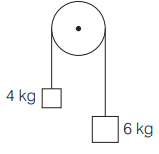
4 pointsTwo bodies of mass \(\begin{align}4\text{ }kg\end{align}\) and \(\begin{align}6\text{ }kg\end{align}\) are tied to the ends of a massless string. The string passes over a pulley which is frictionless (see figure). The acceleration of the system in terms of acceleration due to gravity \(\begin{align}g\end{align}\) is
-
Question 30 of 66
30. Question
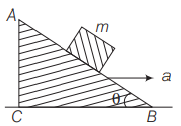
4 pointsA block of mass \(\begin{align}m\end{align}\) is placed on a smooth inclined wedge \(\begin{align}ABC\end{align}\) of inclination \(\begin{align}\theta \end{align}\) as shown in the figure. The wedge is given an acceleration a towards the right. The relation between \(\begin{align}a\end{align}\) and \(\begin{align}\theta \end{align}\) for the block to remain stationary on the wedge is
-
Question 31 of 66
31. Question
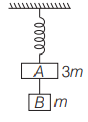
4 pointsTwo blocks \(\begin{align}A\end{align}\) and \(\begin{align}B\end{align}\) of masses \(\begin{align}3m\end{align}\) and \(\begin{align}m\end{align}\) respectively are connected by a massless and inextensible string. The whole system is suspended by a mass less spring as shown in figure. The magnitudes of acceleration of \(\begin{align}A\end{align}\) and \(\begin{align}B\end{align}\) immediately after the string is cut, are respectively
-
Question 32 of 66
32. Question
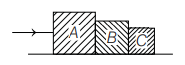
4 pointsThree blocks \(\begin{align}A\text{ }B\end{align}\), and \(\begin{align}C\end{align}\) of masses\(\begin{align}4\text{ }kg\end{align}\), \(\begin{align}2\text{ }kg\end{align}\) and \(\begin{align}1\text{ }kg\end{align}\)respectively, are in contact on a frictionless surface, as shown. If a force of \(\begin{align}14\text{ }N\end{align}\) is applied on the \(\begin{align}4\text{ }kg\end{align}\)block, then the contact force between \(\begin{align}A\end{align}\) and \(\begin{align}B\end{align}\)is
-
Question 33 of 66
33. Question
4 pointsA person of mass \(\begin{align}60\text{ }kg\end{align}\)is inside a lift of mass \(\begin{align}940\text{ }kg\end{align}\)and presses the button on control panel. The lift starts moving upwards with an acceleration \(\begin{align}1.0\text{ }m/{{s}^{2}}\end{align}\). If \(\begin{align}g\text{ }=10m/{{s}^{2}}\end{align}\) , the tension in the supporting cable is
-
Question 34 of 66
34. Question
4 pointsThe mass of a lift is \(\begin{align}2000\text{ }kg\end{align}\). When the tension in the supporting cable is \(\begin{align}28000\text{ }N\end{align}\), then its acceleration is
-
Question 35 of 66
35. Question
4 pointsThree forces acting on a body are shown in the figure. To have the resultant force only along the \(\begin{align}y\end{align}\)-direction, the magnitude of the minimum additional force needed is

-
Question 36 of 66
36. Question
4 pointsA monkey of mass \(\begin{align}20\text{ }kg\end{align}\)is holding a vertical rope. The rope will not break, when a mass of \(\begin{align}25\text{ }kg\end{align}\)is suspended from it but will break, if the mass exceeds \(\begin{align}25\text{ }kg\end{align}\). What is the maximum acceleration with which the monkey can climb up along the rope? \(\begin{align}\left( {Take\,g=10\text{ }m/{{s}^{2}}} \right)\end{align}\)
-
Question 37 of 66
37. Question
4 pointsA man weighs \(\begin{align}80\text{ }kg\end{align}\). He stands on a weighing scale in a lift which is moving upwards with a uniform acceleration of \(\begin{align}5\text{ }m/{{s}^{2}}\end{align}\) . What would be the reading on the scale? \(\begin{align}\left( {Take\text{ }10\text{ }m/{{s}^{2}}} \right)\text{ }\end{align}\)
-
Question 38 of 66
38. Question
4 pointsA lift of mass \(\begin{align}1000\text{ }kg\end{align}\) is moving upwards with an acceleration of \(\begin{align}1\text{ }m/{{s}^{2}}\end{align}\). The tension developed in the string, which is connected to lift is \(\begin{align}\left( {g=9.8\text{ }m/{{s}^{2}}} \right)\text{ }\end{align}\)
-
Question 39 of 66
39. Question
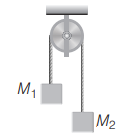
4 pointsTwo masses \(\begin{align}{{M}_{1}}=\text{ }5\text{ }kg,{{M}^{2}}=10kg\text{ }\end{align}\)are connected at the ends of an inextensible string passing over a frictionless pulley as shown. When masses are released, then acceleration of masses will be
-
Question 40 of 66
40. Question
4 pointsA mass of \(\begin{align}1\text{ }kg\end{align}\) is suspended by a thread. It is \(\begin{align}1\end{align}\). lifted up with an acceleration \(\begin{align}4.9\text{ }m/{{s}^{2}}\end{align}\) , \(\begin{align}2\end{align}\). lowered with an acceleration \(\begin{align}4.9\text{ }m/{{s}^{2}}\end{align}\). The ratio of the tensions is
-
Question 41 of 66
41. Question
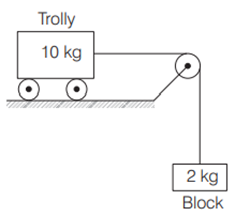
4 pointsCalculate the acceleration of the block and trolly system shown in the figure. The coefficient of kinetic friction between the trolly and the surface is \(\begin{align}0.05.(g=10\text{ }m/{{s}^{2}}\end{align}\), mass of the string is negligible and no other friction exists).
-
Question 42 of 66
42. Question
4 pointsTwo particles \(\begin{align}A\end{align}\) and \(\begin{align}B\end{align}\) are moving in uniform circular motion in concentric circles of radii \(\begin{align}{{r}_{A}}\end{align}\) and \(\begin{align}{{r}_{B}}\end{align}\) with speed \(\begin{align}{{v}_{A}}\end{align}\) and \(\begin{align}{{v}_{B}}\end{align}\) respectively. Their time period of rotation is the same. The ratio of angular speed of \(\begin{align}A\end{align}\) to that of \(\begin{align}B\end{align}\) will be
-
Question 43 of 66
43. Question
4 pointsA body of mass \(\begin{align}m\end{align}\) is kept on a rough horizontal surface \(\begin{align}\left( {coefficient\text{ }of\text{ }friction\text{ }=\text{ }\mu } \right)\end{align}\). Horizontal force is applied on the body, but it does not move. The resultant of normal reaction and the frictional force acting on the object is given \(\begin{align}F\end{align}\), where \(\begin{align}F\end{align}\) is
-
Question 44 of 66
44. Question
4 pointsWhich one of the following statements is incorrect?
-
Question 45 of 66
45. Question
4 pointsA block \(\begin{align}A\end{align}\) of mass \(\begin{align}{{m}_{1}}\end{align}\) rests on a horizontal table. \(\begin{align}A\end{align}\) light string connected to it passes over a frictionless pulley at the edge of table and from its other end another block \(\begin{align}B\end{align}\)of mass \(\begin{align}{{m}_{2}}\end{align}\) is suspended. The coefficient of kinetic friction between the block and the table is \(\begin{align}{{\mu }_{k}}\end{align}\) . When the block \(\begin{align}A\end{align}\) is sliding on the table, the tension in the string is
-
Question 46 of 66
46. Question
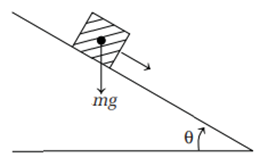
4 pointsA plank with a box on it at one end is gradually raised about the other end. As the angle of inclination with the horizontal reaches \(\begin{align}30{}^\circ \end{align}\), the box starts to slip and slides \(\begin{align}4.0\text{ }m\end{align}\) down the plank in \(\begin{align}4.0\text{ }s\end{align}\). The coefficients of static and kinetic friction between the box and the plank will be, respectively
-
Question 47 of 66
47. Question
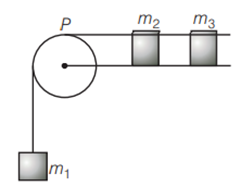
4 pointsA system consists of three masses \(\begin{align}{{m}_{1}},\text{ }{{m}_{2}}\end{align}\) and \(\begin{align}{{m}_{3}}\end{align}\) connected by a string passing over a pulley \(\begin{align}P\end{align}\). The mass \(\begin{align}{{m}_{1}}\end{align}\) hangs freely and \(\begin{align}{{m}_{2}}\end{align}\) and \(\begin{align}{{m}_{3}}\end{align}\) are on a rough horizontal table \(\begin{align}\left( {the\text{ }coefficient\text{ }of\text{ }friction\text{ }=\text{ }\mu } \right)\end{align}\). The pulley is frictionless and of negligible mass. The downward acceleration of mass \(\begin{align}{{m}_{1}}\end{align}\) is \(\begin{align}\left( {Assume,\text{ }{{\text{m}}_{1}}={{m}_{2}}={{m}_{3}}=m} \right)\end{align}\)
-
Question 48 of 66
48. Question
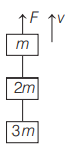
4 pointsThree blocks with masses \(\begin{align}m,\,2m\end{align}\)and \(\begin{align}3m\end{align}\) are connected by strings, as shown in the figure. After an upward force \(\begin{align}F\end{align}\) is applied on block \(\begin{align}m\end{align}\), the masses move upward at constant speed \(\begin{align}v\end{align}\). What is the net force on the block of mass \(\begin{align}2m\end{align}\) ? (\(\begin{align}g\end{align}\) is the acceleration due to gravity).
-
Question 49 of 66
49. Question
4 pointsThe upper half of an inclined plane of inclination \(\begin{align}\theta \text{ }\end{align}\) is perfectly smooth while lower half is rough. \(\begin{align}A\end{align}\) block starting from rest at the top of the plane will again come to rest at the bottom, if the coefficient of friction between the block and lower half of the plane is given by
-
Question 50 of 66
50. Question
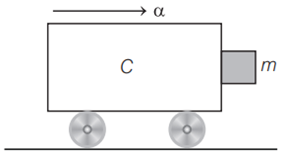
4 pointsA block of mass \(\begin{align}m\end{align}\) is in contact with the cart \(\begin{align}C\end{align}\) as shown in the figure. The coefficient of static friction between the block and the cart is \(\begin{align}\mu \end{align}\). The acceleration \(\begin{align}\alpha \end{align}\) of the cart that will prevent the block from falling satisfies
-
Question 51 of 66
51. Question
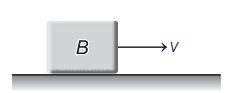
4 pointsA block \(\begin{align}B\end{align}\)is pushed momentarily along a horizontal surface with an initial velocity \(\begin{align}v\end{align}\). If \(\begin{align}\mu \end{align}\) is the coefficient of sliding friction between \(\begin{align}B\end{align}\)and the surface, block \(\begin{align}B\end{align}\) will come to rest after a time IMAGE 16
-
Question 52 of 66
52. Question
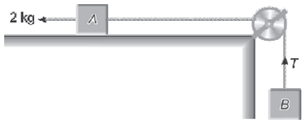
4 pointsThe coefficient of static friction, \(\begin{align}{{\mu }_{s}}\end{align}\) , between block \(\begin{align}A\end{align}\) of mass \(\begin{align}2\,kg\end{align}\) and the table as shown in the figure, is \(\begin{align}0.2\end{align}\). What would be the maximum mass value of block \(\begin{align}B\end{align}\), so that the two blocks do not move ? The string and the pulley are assumed to be smooth and massless \(\begin{align}(g=10m/{{s}^{2}})\end{align}\)
-
Question 53 of 66
53. Question
4 pointsA block of mass \(\begin{align}10\,kg\end{align}\)is placed on a rough horizontal surface having coefficient of friction\(\begin{align}\mu =0.5\end{align}\) . If a horizontal force of \(\begin{align}100\text{ }N\end{align}\) is applied on it, then the acceleration of the block will be \(\begin{align}(Takeg=10m/{{s}^{2}})\end{align}\)
-
Question 54 of 66
54. Question
4 pointsA block has been placed on an inclined plane with the slope angle \(\begin{align}\theta \end{align}\), block slides down the plane at constant speed. The coefficient of kinetic friction is equal to
-
Question 55 of 66
55. Question
4 pointsConsider, a car moving along a straight horizontal road with a speed of \(\begin{align}72\text{ }km/h\end{align}\). If the coefficient of static friction between the tyres and the road is \(\begin{align}0.5\end{align}\), the shortest distance in which the car can be stopped is \(\begin{align}(Take\,g=10m/{{s}^{2}})\end{align}\)
-
Question 56 of 66
56. Question
4 pointsA heavy uniform chain lies on horizontal table top. If the coefficient of friction between the chain and the table surface is \(\begin{align}0.25\end{align}\), then the maximum friction of the length of the chain that can hang over one edge of the table is
-
Question 57 of 66
57. Question
4 pointsStarting from rest, a body slides down a \(\begin{align}45{}^\circ \end{align}\) inclined plane in twice the time it takes to slide down the same distance in the absence of friction. The coefficient of friction between the body and the inclined plane is
-
Question 58 of 66
58. Question
4 pointsA block of mass \(\begin{align}10\,kg\end{align}\)is in contact against the inner wall of a hollow cylindrical drum of radius \(\begin{align}1\,m\end{align}\). The coefficient of friction between the block and the inner wall of the cylinder is \(\begin{align}0.1\end{align}\). The minimum angular velocity needed for the cylinder to keep the block stationary when the cylinder is vertical and rotating about its axis, will be \(\begin{align}(g=10m/{{s}^{2}})\end{align}\)
-
Question 59 of 66
59. Question
4 pointsOne end of the string of length \(\begin{align}I\end{align}\) is connected to a particle of mass m and the other end is connected to a small peg on a smooth horizontal table. If the particle moves in circle with speed \(\begin{align}v\end{align}\), the net force on the particle (directed towards center) will be (\(\begin{align}T\end{align}\) represents the tension in the string)
-
Question 60 of 66
60. Question
4 pointsA uniform circular disc of radius \(\begin{align}50\text{ }cm\end{align}\) at rest is free to turn about an axis which is perpendicular to its plane and passes through its centre. It is subjected to a torque which produces a constant angular acceleration of \(\begin{align}2.0\text{ }rad\,{{s}^{{-2}}}\end{align}\) . Its net acceleration in \(\begin{align}m{{s}^{{-2}}}\end{align}\) at the end of \(\begin{align}2.0\,s\end{align}\) is \(\begin{align}a\end{align}\) approximately
-
Question 61 of 66
61. Question
4 pointsA car is negotiating a curved road of radius \(\begin{align}\text{R}\end{align}\). The road is banked at angle \(\begin{align}\theta \end{align}\). The coefficient of friction between the tyres of the car and the road is \(\begin{align}{{\mu }_{s}}\end{align}\) . The maximum safe velocity on this road is
-
Question 62 of 66
62. Question
4 pointsA car of mass \(\begin{align}1000\text{ }kg\end{align}\) negotiates a banked curve of radius \(\begin{align}90\text{ }m\end{align}\) on a frictionless road. If the banking angle is \(\begin{align}45{}^\circ \end{align}\), the speed of the car is
-
Question 63 of 66
63. Question
4 pointsA gramophone record is revolving with an angular velocity \(\begin{align}\omega \end{align}\). \(\begin{align}A\end{align}\) coin is placed at a distancer from the centre of the record. The static coefficient of friction is \(\begin{align}\mu \end{align}\). The coin will revolve with the record if
-
Question 64 of 66
64. Question
4 pointsA ball of mass \(\begin{align}0.25\text{ }kg\end{align}\)attached to the end of a string of length \(\begin{align}1.96\text{ }m\end{align}\) is moving in a horizontal circle. The string will break if the tension is more than \(\begin{align}25\text{ }N\end{align}\). What is the maximum speed with which the ball can be moved ?
-
Question 65 of 66
65. Question
4 pointsWhat will be the maximum speed of a car on a road turn of radius \(\begin{align}30\text{ }m\end{align}\), if the coefficient of friction between the tyres and the road is \(\begin{align}0.4\end{align}\) ? \(\begin{align}\left( {Takeg\text{ }=9.8\text{ }m/{{s}^{2}}} \right)\end{align}\)
-
Question 66 of 66
66. Question
4 pointsTwo racing cars of masses \(\begin{align}m\end{align}\) and \(\begin{align}4\,m\end{align}\) are moving in circles of radii \(\begin{align}r\end{align}\) and \(\begin{align}2\,r\end{align}\) respectively. If their speeds are such that each makes a complete circle in the same time, then the ratio of the angular speeds of the first to the second car is
