
Chapter: Morphology of Flowering Plants
0 of 30 questions completed
Questions:
- 1
- 2
- 3
- 4
- 5
- 6
- 7
- 8
- 9
- 10
- 11
- 12
- 13
- 14
- 15
- 16
- 17
- 18
- 19
- 20
- 21
- 22
- 23
- 24
- 25
- 26
- 27
- 28
- 29
- 30
Information
Subject: Biology
Syllabus: Morphology of Flowering Plants
Duration: 30 min.
Read the following instruction carefully.
- There are 30 total questions in this test
- Each question has 4 options out of which only one is correct.
- You will be awarded 4 points for each correct answer and 1 point will be deducted for each wrong answer.
- Try not to guess the answer as there is negative marking.
- Your Score & Rank will be shown after submitting the test.
- In this quiz you are going to check your conceptual knowledge.
You have already completed the Test before. Hence you can not start it again.
Test is loading...
You must sign in or sign up to start the Test.
You have to finish following quiz, to start this Test:
Your results are here!! for" 23_Mock_Neet_Bio_L1_Chapter 5 : Morphology of Flowering Plants "
0 of 30 questions answered correctly
Your time:
Time has elapsed
Your Final Score is : 0
You have attempted : 0
Number of Correct Questions : 0 and scored 0
Number of Incorrect Questions : 0 and Negative marks 0
| Average score |
|
| Your score |
|
-
Not categorized
You have attempted: 0
Number of Correct Questions: 0 and scored 0
Number of Incorrect Questions: 0 and Negative marks 0
-
Neet_Mock_Bio_L1
You have attempted: 0
Number of Correct Questions: 0 and scored 0
Number of Incorrect Questions: 0 and Negative marks 0
-
Dear $form{0} you have completed this test.
| Pos. | Name | Entered on | Points | Result |
|---|---|---|---|---|
| Table is loading | ||||
| No data available | ||||
- 1
- 2
- 3
- 4
- 5
- 6
- 7
- 8
- 9
- 10
- 11
- 12
- 13
- 14
- 15
- 16
- 17
- 18
- 19
- 20
- 21
- 22
- 23
- 24
- 25
- 26
- 27
- 28
- 29
- 30
- Answered
- Review
-
Question 1 of 30
1. Question
4 pointsIdentify the correct order (root) from base to root apex
I. Mineral absorption zone
II. Soil penetration zone
III. Cell number increasement zone
IV. Cell elongation zone -
Question 2 of 30
2. Question
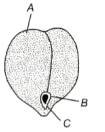
4 pointsIdentify A, B and C in the given diagram.
-
Question 3 of 30
3. Question
4 pointsStudy the following statements and choose the correct option.
I.Buds are present in the axil of leaflets of the compound leaf.
II.Pulvinus leaf-base is present in some leguminous plants.
III.In Alstonia, the petioles expand, become green and synthesize food.
IV.Opposite phyllotaxy is seen in guava. -
Question 4 of 30
4. Question
4 pointsThe number of stomata present per cm2 of a leaf is
-
Question 5 of 30
5. Question
4 pointsThe triploid number of chromosomes of the first taxon in 10 times more than the haploid number of chromosomes of the second taxon, while the diploid number of the third taxon is six time more than the haploid number of the fourth taxon. Which one of the following shows the ascending order of the number of chromosomes in their respective endosperm?
-
Question 6 of 30
6. Question
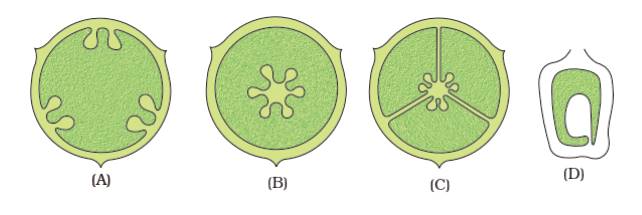
4 pointsIn the diagram of types of placentation given above ‘A’, ‘B’, ‘C’, and ‘D’ respectively represent
-
Question 7 of 30
7. Question
4 pointsWhich of the following plants has haustorial roots?
-
Question 8 of 30
8. Question
4 pointsFlowers are zygomorphic in
-
Question 9 of 30
9. Question
4 pointsPneumatophores are positively
-
Question 10 of 30
10. Question
4 pointsDrupe contains
-
Question 11 of 30
11. Question
4 pointsWhen axillary buds or terminal buds of stem gets modified into woody straight and pointed structure, it is known as
-
Question 12 of 30
12. Question
4 pointsPineapple (ananas) fruit develops from a
-
Question 13 of 30
13. Question
4 pointsFibrous root system originates from the base of
-
Question 14 of 30
14. Question
4 pointsIn the flowers of a plant, the ovarian part is fused, but styles and stigmas are free. Its ovary becomes unilocular due to breakdown of partition wall and the ovules are attached to a central axis. Identify the plant.
-
Question 15 of 30
15. Question
4 pointsCuticle is absent in
-
Question 16 of 30
16. Question
4 pointsWhen gynoecium is present in the topmost position of thalamus, the flower is known as
-
Question 17 of 30
17. Question
4 pointsSelect the correct statements.
I. From the region of elongation, some of the epidermal cells from root hairs.
II. Pneumatophores are seen in Rhizophora
III. Adventitious roots are seen in the banyan tree.
IV. Maize and sugarcane have prop roots. -
Question 18 of 30
18. Question
4 pointsG(2) represents
-
Question 19 of 30
19. Question
4 pointsThe floral formula of the given floral diagram is

-
Question 20 of 30
20. Question
4 pointsEdible part if mango is
-
Question 21 of 30
21. Question
4 pointsHaustoria are found in
-
Question 22 of 30
22. Question
4 pointsHow many types of inflorescence are present in angiosperm depending on whether the apex gets converted into a flower or continuous to grow?
-
Question 23 of 30
23. Question
4 pointsSeedless banana is
-
Question 24 of 30
24. Question
4 pointsLeaf blade is spinous in case of
-
Question 25 of 30
25. Question
4 pointsMain axis continues to grow, the flowers are borne laterally in acropetal succession. This is a characteristic of which type of inflorescence?
-
Question 26 of 30
26. Question
4 pointsInflorescence axis is called
-
Question 27 of 30
27. Question
4 pointsPhylloclades are
-
Question 28 of 30
28. Question
4 pointsProp roots of the banyan tree are meant for
-
Question 29 of 30
29. Question
4 pointsSome plants have rhizomes and roots as underground structures. Which characteristics of rhizome would distinguish them from roots?
-
Question 30 of 30
30. Question
4 pointsDIRECTIONS: Each of these questions contains an assertion followed by reason. Read them carefully and answer the question on the basis of following options. You have to select the one that best describes the two statements.
Assertion A floral formula is the representation of the morphology of a flower with the help of signs and symbols.
Reason An incomplete flower in one where one or more whorls are absent.
