
Chapter: Plant Kingdom – Mock Test -Level 1
0 of 30 questions completed
Questions:
- 1
- 2
- 3
- 4
- 5
- 6
- 7
- 8
- 9
- 10
- 11
- 12
- 13
- 14
- 15
- 16
- 17
- 18
- 19
- 20
- 21
- 22
- 23
- 24
- 25
- 26
- 27
- 28
- 29
- 30
Information
Subject: Biology
Syllabus: Plant Kingdom
Duration: 30 min.
Read the following instruction carefully.
- There are 30 total questions in this test
- Each question has 4 options out of which only one is correct.
- You will be awarded 4 points for each correct answer and 1 point will be deducted for each wrong answer.
- Try not to guess the answer as there is negative marking.
- Your Score & Rank will be shown after submitting the test.
- In this quiz you are going to check your conceptual knowledge.
You have already completed the Test before. Hence you can not start it again.
Test is loading...
You must sign in or sign up to start the Test.
You have to finish following quiz, to start this Test:
Your results are here!! for" 23_Mock_Neet_Bio_L1_Chapter 3 : Plant Kingdom "
0 of 30 questions answered correctly
Your time:
Time has elapsed
Your Final Score is : 0
You have attempted : 0
Number of Correct Questions : 0 and scored 0
Number of Incorrect Questions : 0 and Negative marks 0
| Average score |
|
| Your score |
|
-
Level 1
You have attempted: 0
Number of Correct Questions: 0 and scored 0
Number of Incorrect Questions: 0 and Negative marks 0
-
Dear $form{0} you have completed this test.
| Pos. | Name | Entered on | Points | Result |
|---|---|---|---|---|
| Table is loading | ||||
| No data available | ||||
- 1
- 2
- 3
- 4
- 5
- 6
- 7
- 8
- 9
- 10
- 11
- 12
- 13
- 14
- 15
- 16
- 17
- 18
- 19
- 20
- 21
- 22
- 23
- 24
- 25
- 26
- 27
- 28
- 29
- 30
- Answered
- Review
-
Question 1 of 30
1. Question
4 pointsIn class phaeophyceae, the plant body is usually attached to the substratum by a A and has a stalk, the B and leaf like photosynthetic organ-the C .
-
Question 2 of 30
2. Question
4 points_______ represent the reproductive organs amongst gymnosperms.
-
Question 3 of 30
3. Question
4 pointsAlgin, carrageen and proteins are obtained from
-
Question 4 of 30
4. Question
4 pointsIn bryophytes, male and female sex organs are called ______ and ______ respectively.
-
Question 5 of 30
5. Question
4 pointsWhich one of the following is the major difference between mosses and ferns ?
-
Question 6 of 30
6. Question
4 pointsProtonema and leafy stage are the predominant stage of the life cycle of
-
Question 7 of 30
7. Question
4 pointsWhich of the following statement is incorrect ?
-
Question 8 of 30
8. Question
4 pointsRead the following statements and choose the correct option.
(i) In rhodophyceae, food is stored in the form of mannitol and laminarin.
(ii) The ovules of gymnosperms are not enclosed by ovary wall.
(iii) Salvinia is heterosporous.
(iv) In the diplontic life-cycle, the free living gametophyte represents the dominant phase. -
Question 9 of 30
9. Question
4 pointsWhich of the following statements with respect to algae are correct.
(i) Fusion between one large, non-motile female gamete and a smaller, motile male gamete is termed as oogamous.
(ii) Fusion of two gametes dissimilar in size is termed as oogamous.
(iii) Fusion of two gametes similar in size is called anisogamous.
(iv) In chlorophyceae, the major pigments are chlorophyll a and b , and the food is stored as starch.
(v) In rhodophyceae, the major pigments are chlorophyll a and d , and the food is stored as mannitol. -
Question 10 of 30
10. Question
4 pointsWhich of the following statement(s) is/are correct about pteridophytes ?
(i) The main plant body is a sporophyte which is differentiated into true roots and leaves.
(ii) The leaves are small (microphylls) as in ferns or large (macrophylls) as in Selaginella.
(iii) Genera like Selaginella and Salvinia which produce two kinds of spores–macro (large) and micro (small) spores, are known as heterospores.
(iv) Common examples are Funaria, Polytrichum and Sphagnum. -
Question 11 of 30
11. Question
4 pointsMatch the column-I with column-II and choose the correct option.
Column-I Column-II
A. Amphibian of the plant kingdom I. Sphagnum
B. Specialized structures in liverworts for asexual reproduction II. Angiosperms
C. Monocotyledons and dicotyledons III. Bryophytes
D. A plant which has capacity to holding water IV. Gemmae -
Question 12 of 30
12. Question
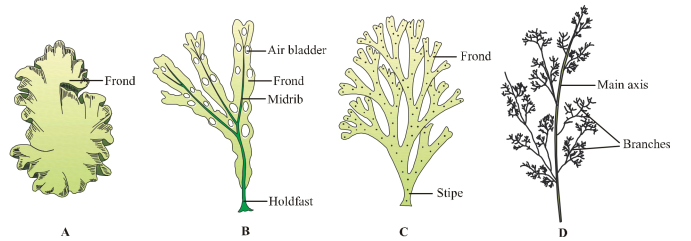
4 pointsThe given figures (A, B, C, D) represent the members algae. Identify the correct option for the given diagrams.
-
Question 13 of 30
13. Question
4 pointsFern plant is a
-
Question 14 of 30
14. Question
4 pointsIf the cells of root in wheat plant have 42 chromosomes, then the no. of chromosome in the cell of pollen grain is
-
Question 15 of 30
15. Question
4 pointsChemotaxonomy is connected with
-
Question 16 of 30
16. Question
4 pointsDeep in the tropical rain forest, a botanist discovered an unusual plant with vascular tissues, stomata, a cuticle, flagellated sperm, cone-like reproductive structures bearing seeds, and an alternation-of-generations life cycle. He was very excited about this discovery because it would be rather unusual for a plant to have both
-
Question 17 of 30
17. Question
4 pointsAcetabularia, a largest unicellular plant, belongs to –
-
Question 18 of 30
18. Question
4 pointsPolyuronic acid and polysulphate esters are characteristic in cell wall of
-
Question 19 of 30
19. Question
4 pointsThe name “ Thallophyta ” was coined by –
-
Question 20 of 30
20. Question
4 pointsEmbryo is present but true vasculature is absent in phylum –
-
Question 21 of 30
21. Question
4 pointsIn bryophyta, organs are referred to as “Leaf like” and “Stem like” and not the true leaf and stem because –
-
Question 22 of 30
22. Question
4 pointsTrabecullae are present in
-
Question 23 of 30
23. Question
4 points4 rows and 6 rows of NCC are found respectively in
-
Question 24 of 30
24. Question
4 pointsDIRECTIONS: Each of these questions contains an assertion followed by reason. Read them carefully and answer the question on the basis of following options. You have to select the one that best describes the two statements.
Assertion Gymnodinium is red tide causing alga.
Reason Phycoerythrin is responsible for red colour. -
Question 25 of 30
25. Question
4 pointsHeterospory is found in
-
Question 26 of 30
26. Question
4 pointsWhich dominant trees of past are today’s coal
-
Question 27 of 30
27. Question
4 pointsWhere the microsporangia are located in gymnosperms
-
Question 28 of 30
28. Question
4 pointsSmallest angiosperm with smallest flower is
-
Question 29 of 30
29. Question
4 pointsWhich is/are wrong–
(A) Phylogentic classification system : based on evolutionary relationship between the various organism
(B) Numerical Taxonomy : Use of computers
(C) Cytotaxonomy : Based on cytological information like chromosome number, structure.
(D) Chemotaxonomy : Based on study of experimental determination of thegenetic interrelationship. -
Question 30 of 30
30. Question
4 pointsRoots in some genera of gymnosperm have fungal association in the form of mycorrhiza ____(i)_____ wihle in some others ___(ii)____ samll specialised roots called coralloid roots are associated with N2 fixing cyanobacteria. The stem are unbranched ___(iii)____ or branched ___(iv)____in this question (i), (ii), (iii) & (iv) are respectively.
