
Chapter: Ecosystem
0 of 74 questions completed
Questions:
- 1
- 2
- 3
- 4
- 5
- 6
- 7
- 8
- 9
- 10
- 11
- 12
- 13
- 14
- 15
- 16
- 17
- 18
- 19
- 20
- 21
- 22
- 23
- 24
- 25
- 26
- 27
- 28
- 29
- 30
- 31
- 32
- 33
- 34
- 35
- 36
- 37
- 38
- 39
- 40
- 41
- 42
- 43
- 44
- 45
- 46
- 47
- 48
- 49
- 50
- 51
- 52
- 53
- 54
- 55
- 56
- 57
- 58
- 59
- 60
- 61
- 62
- 63
- 64
- 65
- 66
- 67
- 68
- 69
- 70
- 71
- 72
- 73
- 74
Information
Subject: Biology
Syllabus: Ecosystem
Duration: 1 Hr.
Read the following instruction carefully.
- There are 74 total questions in this test
- Each question has 4 options out of which only one is correct.
- You will be awarded 4 points for each correct answer and 1 point will be deducted for each wrong answer.
- Try not to guess the answer as there is negative marking.
- Your Score & Rank will be shown after submitting the test.
- In this quiz you are going to check your conceptual knowledge.
You have already completed the Test before. Hence you can not start it again.
Test is loading...
You must sign in or sign up to start the Test.
You have to finish following quiz, to start this Test:
Your results are here!! for" NPY_12_Bio_36_14_Ecosystem "
0 of 74 questions answered correctly
Your time:
Time has elapsed
Your Final Score is : 0
You have attempted : 0
Number of Correct Questions : 0 and scored 0
Number of Incorrect Questions : 0 and Negative marks 0
| Average score |
|
| Your score |
|
-
Level 1
You have attempted: 0
Number of Correct Questions: 0 and scored 0
Number of Incorrect Questions: 0 and Negative marks 0
-
Dear $form{0} you have completed this test.
| Pos. | Name | Entered on | Points | Result |
|---|---|---|---|---|
| Table is loading | ||||
| No data available | ||||
- 1
- 2
- 3
- 4
- 5
- 6
- 7
- 8
- 9
- 10
- 11
- 12
- 13
- 14
- 15
- 16
- 17
- 18
- 19
- 20
- 21
- 22
- 23
- 24
- 25
- 26
- 27
- 28
- 29
- 30
- 31
- 32
- 33
- 34
- 35
- 36
- 37
- 38
- 39
- 40
- 41
- 42
- 43
- 44
- 45
- 46
- 47
- 48
- 49
- 50
- 51
- 52
- 53
- 54
- 55
- 56
- 57
- 58
- 59
- 60
- 61
- 62
- 63
- 64
- 65
- 66
- 67
- 68
- 69
- 70
- 71
- 72
- 73
- 74
- Answered
- Review
-
Question 1 of 74
1. Question
4 pointsWhich one of the following processes during decomposition is correctly described?
-
Question 2 of 74
2. Question
4 pointsWhich ecosystem has the maximum biomass?
-
Question 3 of 74
3. Question
4 pointsPresence of plants arranged into well defined vertical layers depending on their height can best seen best in
-
Question 4 of 74
4. Question
4 pointsThe term ecosystem was coined by
-
Question 5 of 74
5. Question
4 pointsWhich one of the following is a characteristic feature of cropland ecosystem?
-
Question 6 of 74
6. Question
4 pointsThe primary producers of the deep-sea hydrothermal vent ecosystem are
-
Question 7 of 74
7. Question
4 pointsWhich one of the following is not a functional unit of an ecosystem?
-
Question 8 of 74
8. Question
4 pointsQuercus species are the dominant component in
-
Question 9 of 74
9. Question
4 pointsThe slow rate of decomposition of fallen logs in nature is due to their
-
Question 10 of 74
10. Question
4 pointsAn ecosystem which can be easily damaged but can recover after some time if damaging effect stops, will be having
-
Question 11 of 74
11. Question
4 pointsWhich of the following is the most stable ecosystem?
-
Question 12 of 74
12. Question
4 pointsWhat is true of ecosystem?
-
Question 13 of 74
13. Question
4 pointsIn an ecosystem, which one shows one-way passage
-
Question 14 of 74
14. Question
4 pointsDecomposers are organisms that
-
Question 15 of 74
15. Question
4 pointsIn the equation GPP − R = NPP, R represents
-
Question 16 of 74
16. Question
4 pointsThe rate of decomposition is faster in the ecosystem due to following factors except
-
Question 17 of 74
17. Question
4 pointsWhich of the following statements is incorrect?
-
Question 18 of 74
18. Question
4 pointsMatch the trophic levels with their correct species examples in grassland ecosystem.
Column I Column II
A. Fourth trophic level 1. Crow
B. Second trophic level 2. Vulture
C. First trophic level 3. Rabbit
D. Third trophic level 4. Grass
Select the correct option. -
Question 19 of 74
19. Question
4 pointsIn relation to gross primary productivity and net primary productivity of an ecosystem, which one of the following statements is correct?
-
Question 20 of 74
20. Question
4 pointsMost animals that in deep oceanic water are
-
Question 21 of 74
21. Question
4 pointsIf 20 J of energy is trapped at producer level, then how much energy will be available to peacock as food in the following chain?
Plant → Mice → Snake → Peacock -
Question 22 of 74
22. Question
4 pointsSecondary productivity is rate of formation of new organic matter by
-
Question 23 of 74
23. Question
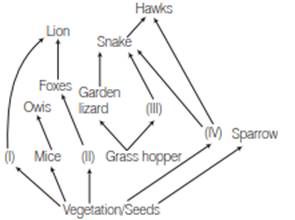
4 pointsIdentify the likely organisms I, II, III and IV in the food web shown below.
-
Question 24 of 74
24. Question
4 pointsIdentify the possible link ‘A’ in the following food chain
Plant → Insect → Frog → ‘A’ →Eagle -
Question 25 of 74
25. Question
4 pointsMass of living matter at a trophic level in an area at any time is called
-
Question 26 of 74
26. Question
4 pointsOf the total incident solar radiation the proportion of PAR is
-
Question 27 of 74
27. Question
4 pointsThe biomass available for consumption by the herbivores and the decomposers is called
-
Question 28 of 74
28. Question
4 pointsThe correct sequence of plants in a hydrosere is
-
Question 29 of 74
29. Question
4 pointsWhich one of the following types of organisms occupy more than one trophic level in a pond ecosystem?
-
Question 30 of 74
30. Question
4 pointsConsider the following statements concerning food chains.
I. Removal of 80% tigers from an area resulted in greatly increased growth of vegetation
II. Removal of most of the carnivores resulted in an increased population of deers
III. The length of food chains is generally limited to 3-4 trophic levels due to energy loss
IV. The length of food chains may vary from 2 to 8 trophic levels
Which of the two above statements are correct? -
Question 31 of 74
31. Question
4 pointsWhich of the following ecosystem types has the highest annual net primary productivity?
-
Question 32 of 74
32. Question
4 pointsWhich of the following is expected to have the highest value (gm /m2 /yr) in a grassland ecosystem?
-
Question 33 of 74
33. Question
4 pointsBamboo plant is growing in a far forest then what will be the trophic level of it?
-
Question 34 of 74
34. Question
4 pointsThe transfer of energy from one trophic level to another is governed by the 2nd law of thermodynamics. The average efficiency of energy transfer from herbivores to carnivores is
-
Question 35 of 74
35. Question
4 pointsThe rate at which light energy is converted into chemical energy of organic molecules is theecosystem’s
-
Question 36 of 74
36. Question
4 pointsWhich of the following ecosystem has the highest gross primary productivity?
-
Question 37 of 74
37. Question
4 pointsIn a biotic community, the primary consumers are
-
Question 38 of 74
38. Question
4 pointsIf we completely remove the decomposers from an ecosystem, its functioning will be adversely affected, because
-
Question 39 of 74
39. Question
4 pointsIn grass-deer-tiger food chain, grass biogass is one tonne. The tiger biomass shall be
-
Question 40 of 74
40. Question
4 pointsSecond most important trophic level in a lake is
-
Question 41 of 74
41. Question
4 pointsFood chain in which microorganisms breakdown the food formed by primary producers are
-
Question 42 of 74
42. Question
4 pointsPick up the correct food chain.
-
Question 43 of 74
43. Question
4 pointsUpper part of sea/aquatic ecosystem contains
-
Question 44 of 74
44. Question
4 pointsWhich of the following statemen is not correct?
-
Question 45 of 74
45. Question
4 pointsWhich of the following ecological pyramids is generally inverted?
-
Question 46 of 74
46. Question
4 pointsWhat type of ecological pyramid would be obtained with the following data?Secondary consumer : 120 g Primary consumer : 60 g Primary producer : 10 g
-
Question 47 of 74
47. Question
4 pointsDuring ecological succession
-
Question 48 of 74
48. Question
4 pointsMatch the following and select the correct option.
Column I Column II
A. Earthworm 1. Pioneer species
B. Succession 2. Detritivore
C. Ecosystem service 3. Natality
D. Population growth 4. Pollination -
Question 49 of 74
49. Question
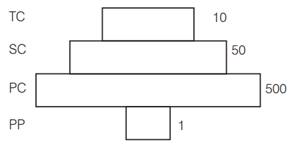
4 pointsGiven below is an imaginary pyramid of numbers. What could be one of the possibilities about certain organisms at some of the different levels?
-
Question 50 of 74
50. Question
4 pointsThe upright pyramid of number is absent in
-
Question 51 of 74
51. Question
4 pointsThe second stage of hydrosere is occupied by plants like
-
Question 52 of 74
52. Question
4 pointsWhich one of the following statements is correct for secondary succession?
-
Question 53 of 74
53. Question
4 pointsWhich one of the following statements for pyramid of energy is incorrect whereas the remaining three are correct?
-
Question 54 of 74
54. Question
4 pointsWhich one of the following is not used for constructing of ecological pyramids?
-
Question 55 of 74
55. Question
4 pointsThe greatest biomass of autotrophs in the world’s oceans is that of
-
Question 56 of 74
56. Question
4 pointsIn a terrestrial ecosystem such as forest, maximum energy is in which trophic level?
-
Question 57 of 74
57. Question
4 pointsIn a food chain, the largest population is that of
-
Question 58 of 74
58. Question
4 pointsThe nature of climax community ultimately depends on
-
Question 59 of 74
59. Question
4 pointsThe primary succession refers to the development of communities on a
-
Question 60 of 74
60. Question
4 pointsThe pyramid which cannot be inverted in a stable ecosystem is that of
-
Question 61 of 74
61. Question
4 pointsPyramid of number deals with number of
-
Question 62 of 74
62. Question
4 pointsPyramid of number in a pond ecosystem is
-
Question 63 of 74
63. Question
4 pointsThe amount of nutrients, such as carbon, nitrogen, phosphorus and calcium present in the soil at any given time, is referred as
-
Question 64 of 74
64. Question
4 pointsWhich of the following statements is incorrect regarding the phosphorus cycle?
-
Question 65 of 74
65. Question
4 pointsIn which of the following both pairs have correct combination?
-
Question 66 of 74
66. Question
4 pointsGiven below is a simplified model of phosphorus cycling in a terrestrial ecosystem with four blanks (A-D). Identify the blanks
A B C D
(P) Rock minerals Detritus Litter fall Producers
(Q) Litter fall Producers Rock minerals Detritus
(R) Detritus Rock minerals Producer Litter fall
(S) Producers Litter fall Rock minerals Detritus -
Question 67 of 74
67. Question
4 pointsNatural reservoir of phosphorus is
-
Question 68 of 74
68. Question
4 pointsWhich one of the following is not a gaseous biogeochemical cycle in ecosystem?
-
Question 69 of 74
69. Question
4 pointsAbout 70% of total global carbon is found in
-
Question 70 of 74
70. Question
4 pointsWhich one of the following pair is mismatched?
-
Question 71 of 74
71. Question
4 pointsIf by radiation all nitrogenase enzymes are inactivated, then there will be no
-
Question 72 of 74
72. Question
4 pointsWhich of the following pair is a sedimentary type of biogeochemical cycle?
-
Question 73 of 74
73. Question
4 pointsThe main role of bacteria in the carbon cycle involves
-
Question 74 of 74
74. Question
4 pointsBulk CO2 -fixation occurs in
