
Chapter: Microbes in Human Welfare
0 of 68 questions completed
Questions:
- 1
- 2
- 3
- 4
- 5
- 6
- 7
- 8
- 9
- 10
- 11
- 12
- 13
- 14
- 15
- 16
- 17
- 18
- 19
- 20
- 21
- 22
- 23
- 24
- 25
- 26
- 27
- 28
- 29
- 30
- 31
- 32
- 33
- 34
- 35
- 36
- 37
- 38
- 39
- 40
- 41
- 42
- 43
- 44
- 45
- 46
- 47
- 48
- 49
- 50
- 51
- 52
- 53
- 54
- 55
- 56
- 57
- 58
- 59
- 60
- 61
- 62
- 63
- 64
- 65
- 66
- 67
- 68
Information
Subject: Biology
Syllabus: Biotechnology Principles and Processes
Duration: 1 Hr.
Read the following instruction carefully.
- There are 68 total questions in this test
- Each question has 4 options out of which only one is correct.
- You will be awarded 4 points for each correct answer and 1 point will be deducted for each wrong answer.
- Try not to guess the answer as there is negative marking.
- Your Score & Rank will be shown after submitting the test.
- In this quiz you are going to check your conceptual knowledge.
You have already completed the Test before. Hence you can not start it again.
Test is loading...
You must sign in or sign up to start the Test.
You have to finish following quiz, to start this Test:
Your results are here!! for" NPY_12_Bio_33_11_Biotechnology Principles and Processes "
0 of 68 questions answered correctly
Your time:
Time has elapsed
Your Final Score is : 0
You have attempted : 0
Number of Correct Questions : 0 and scored 0
Number of Incorrect Questions : 0 and Negative marks 0
| Average score |
|
| Your score |
|
-
Not categorized
You have attempted: 0
Number of Correct Questions: 0 and scored 0
Number of Incorrect Questions: 0 and Negative marks 0
-
Level 1
You have attempted: 0
Number of Correct Questions: 0 and scored 0
Number of Incorrect Questions: 0 and Negative marks 0
-
Dear $form{0} you have completed this test.
| Pos. | Name | Entered on | Points | Result |
|---|---|---|---|---|
| Table is loading | ||||
| No data available | ||||
- 1
- 2
- 3
- 4
- 5
- 6
- 7
- 8
- 9
- 10
- 11
- 12
- 13
- 14
- 15
- 16
- 17
- 18
- 19
- 20
- 21
- 22
- 23
- 24
- 25
- 26
- 27
- 28
- 29
- 30
- 31
- 32
- 33
- 34
- 35
- 36
- 37
- 38
- 39
- 40
- 41
- 42
- 43
- 44
- 45
- 46
- 47
- 48
- 49
- 50
- 51
- 52
- 53
- 54
- 55
- 56
- 57
- 58
- 59
- 60
- 61
- 62
- 63
- 64
- 65
- 66
- 67
- 68
- Answered
- Review
-
Question 1 of 68
1. Question
4 pointsPlasmid pBR322 has Pst I restriction enzyme site within gene ampR that confers ampicillin resistance. If this enzyme is used for inserting a gene for β-galactoside production and the recombinant plasmid is inserted in an E.coli strain
-
Question 2 of 68
2. Question
4 pointsA specific recognition sequence identified by endonucleases to make cuts at specific positions within the DNA is
-
Question 3 of 68
3. Question
4 pointsMatch the following techniques or instruments with their usage.Column I Column IIA. Bioreactor (i) Separation of DNA fragmentsB. Electroph-oresis (ii) Production of large quantities of productsC. PCR (iii) Detection of pathogen, based on antigen-antibody reactionD. ELISA (iv) Amplification of nucleic acids
-
Question 4 of 68
4. Question
4 pointsFirst discovered restriction endonuclease that always cuts DNA molecule at a particular point by recognising a specific sequence of six base pairs is
-
Question 5 of 68
5. Question
4 pointsChoose the correct pair from the following.
-
Question 6 of 68
6. Question
4 pointsIdentify the wrong statement with regard to restriction enzymes.
-
Question 7 of 68
7. Question
4 pointsA selectable marker is used to
-
Question 8 of 68
8. Question
4 pointsThe two antibiotic resistant genes on vector pBR322 are for
-
Question 9 of 68
9. Question
4 pointsMatch the following enzymes with their functions
Column I Column II
1. Restriction endonuclease i. Joins the DNA fragments
2. Restriction exonuclease ii. Extends primers on genomic DNA template
3. DNA ligase iii. Cuts DNA at specific position
4. Taq polymerase iv. Removes nucleotides from the ends of DNA
Select the correct option from the following. -
Question 10 of 68
10. Question
4 pointsFollowing statements describe the characteristics of the enzyme Restriction Endonuclease. Identify the incorrect statement.
-
Question 11 of 68
11. Question
4 pointsWhich of the following is commonly used as a vector for introducing a DNA fragment in humanlymphocytes?
-
Question 12 of 68
12. Question
4 pointsA gene, whose expression helps to identify transformed cells is known as
-
Question 13 of 68
13. Question
4 pointsThe DNA fragments separated on an agarose gel can be visualised after staining with
-
Question 14 of 68
14. Question
4 pointsWhich of the following is not feature of the plasmids?
-
Question 15 of 68
15. Question
4 pointsWhich of the following is a restriction endonuclease?
-
Question 16 of 68
16. Question
4 pointsWhich of the following restriction enzymes produces blunt ends?
-
Question 17 of 68
17. Question
4 pointsA foreign DNA and plasmid cut by the same restriction endonuclease can be joined to form a recombinant plasmid using
-
Question 18 of 68
18. Question
4 pointsThe cutting of DNA at specific locations became possible with the discovery of
-
Question 19 of 68
19. Question
4 pointsThe DNA molecule to which the gene of interest is integrated for cloning is called
-
Question 20 of 68
20. Question
4 pointsWhich vector can clone only a small fragment of DNA?
-
Question 21 of 68
21. Question
4 pointsCommonly used vectors for human genome sequencing are
-
Question 22 of 68
22. Question
4 pointsThe colonies of recombinant bacteria appear white in contrast to blue colonies of non-recombinant bacteria because of
-
Question 23 of 68
23. Question
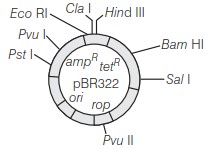
4 pointsThe given figure is the diagrammatic representation of the E. coli vector pBR322. Whichone of the given options correctly identifies its certain component(s)?
-
Question 24 of 68
24. Question
4 pointsA single strand of nucleic acid tagged with a radioactive molecule is called
-
Question 25 of 68
25. Question
4 pointsFor transformation, microparticles coated with DNA to be bombarded with gene gun are made up of
-
Question 26 of 68
26. Question
4 pointsWhich one of the following is a case of wrong matching?
-
Question 27 of 68
27. Question
4 pointsGiven below is a sample of portion of DNA strand giving the base sequence on the opposite strands. What is so, special shown in it?5′— GAATTC — 3′3′ — CTTAAG — 5′
-
Question 28 of 68
28. Question
4 pointsThere is a restriction endonuclease called Eco RI. What does ‘co’ part in it stand for?
-
Question 29 of 68
29. Question
4 pointsWhich one of the following is used as vector for cloning genes into higher organisms?
-
Question 30 of 68
30. Question
4 pointsRestriction endonucleases are enzymes which
-
Question 31 of 68
31. Question
4 pointsThe linking of antibiotic resistance gene with the plasmid vector became possible with
-
Question 32 of 68
32. Question
4 pointsWhich one of the following is commonly used in transfer of foreign DNA into crop plants?
-
Question 33 of 68
33. Question
4 pointsRestriction endonucleases
-
Question 34 of 68
34. Question
4 pointsManipulation of DNA in genetic engineering became possible due to the discovery of
-
Question 35 of 68
35. Question
4 pointsA mutant strain of T4 -bacteriophage R-II, fails to lyse the E. coli but when two strains R-IIx and R-II4 are mixed then they lyse the E. coli. What may be the possible reason?
-
Question 36 of 68
36. Question
4 pointsIn bacteria, plasmid is
-
Question 37 of 68
37. Question
4 pointsPlasmid is
-
Question 38 of 68
38. Question
4 pointsPlasmids are suitable vectors for gene cloning becauseu
-
Question 39 of 68
39. Question
4 pointsThe process of replication in plasmid DNA, other than initiation, is controlled by
-
Question 40 of 68
40. Question
4 pointsWhich of the following is related to genetic engineering?
-
Question 41 of 68
41. Question
4 pointsRecombinant DNA is obtained by cleaving the pro-DNA by
-
Question 42 of 68
42. Question
4 pointsGenetic engineering is possible, because
-
Question 43 of 68
43. Question
4 pointsTwo bacteria found to be very useful in genetic engineering experiments are
-
Question 44 of 68
44. Question
4 pointsDuring the process of gene amplification using PCR, if very high temperature is not maintained in the beginning, then which of the following steps of PCR will be affected first?
-
Question 45 of 68
45. Question
4 pointsWhich of the following is not an application of PCR (Polymerase Chain Reaction)?
-
Question 46 of 68
46. Question
4 pointsDuring the purification process for recombinant DNA technology, addition of chilled ethanol precipitates out
-
Question 47 of 68
47. Question
4 pointsWhich of the following is a correct sequence of steps in a PCR (Polymerase Chain Reaction) ?
-
Question 48 of 68
48. Question
4 pointsSelect the correct statement from the following.
-
Question 49 of 68
49. Question
4 pointsIn a mixture, DNA fragments are separated by
-
Question 50 of 68
50. Question
4 pointsIn recombinant DNA technology antibiotics are used
-
Question 51 of 68
51. Question
4 pointsMatch the following columns and select the correct option.
Column I Column II
A. Bt cotton 1. Gene therapy
B. Adenosine deaminase deficiency 2. Cellular defence
C. RNAi 3. Detection of HIV infection
D. PCR 4. Bacillus thuringiensis -
Question 52 of 68
52. Question
4 pointsIn gel electrophoresis, separated DNA fragments can be visualised with the help of
-
Question 53 of 68
53. Question
4 pointsGiven below are four statements pertaining to separation of DNA fragments using gel electrophoresis. Identify the incorrect statements.
1. DNA is negatively charged molecule and so it is loaded on gel towards the anode terminal.
2. DNA fragments travel along the surface of the gel whose concentration does not affect movement of DNA.
3. Smaller the size of DNA fragment larger is the distance it travels through it.
4. Pure DNA can be visualised directly by exposing UV-radiation.
Select the correct option from the following -
Question 54 of 68
54. Question
4 pointsThe correct order of steps in Polymerase Chain Reaction (PCR) is
-
Question 55 of 68
55. Question
4 pointsThe process of separation and purification of expressed protein before marketing is called
-
Question 56 of 68
56. Question
4 pointsWhat is the criterion for DNA fragments movement on agarose gel during gel electrophoresis?
-
Question 57 of 68
57. Question
4 pointsThe Taq polymerase enzyme is obtained from
-
Question 58 of 68
58. Question
4 pointsWhich of the following is not a component of downstream processing?
-
Question 59 of 68
59. Question
4 pointsStirred-tank bioreactors have been designed for
-
Question 60 of 68
60. Question
4 pointsAn analysis of chromosomal DNA using the Southern hybridisation technique does not use
-
Question 61 of 68
61. Question
4 pointsIn vitro clonal propagation in plants is characterised by
-
Question 62 of 68
62. Question
4 pointsDNA fragments generated by the restriction endonucleases in a chemical reaction can be separated by
-
Question 63 of 68
63. Question
4 pointsPCR and restriction fragment length polymorphism are the methods for
-
Question 64 of 68
64. Question
4 pointsWhich one is a true statement regarding DNA polymerase used in PCR?
-
Question 65 of 68
65. Question
4 pointsAgarose extracted from sea weeds is used in
-
Question 66 of 68
66. Question
4 pointsStirred-tank bioreactors have been designed for
-
Question 67 of 68
67. Question
4 pointsPolyethylene glycol method is used for
-
Question 68 of 68
68. Question
4 pointsGel electrophoresis is used for
